Share:

- Women
- Men
- Kids & Baby
- Workwear
- Footwear
- Accessories
- Home & Living
- Health & Beauty
- Pet Supplies

You're choosing footwear for a real working day, not a catalogue photograph. A roofer may find a hidden nail under a sheet of waste, a warehouse operative may have a pallet truck pass close to the toe, and a kitchen porter may start a shift on wet tiles before sunrise. The right pair needs to match those hazards, fit properly and carry evidence of the protection it claims to provide.
This safety footwear UK guide treats boots, shoes and trainers as regulated PPE first and shopping choices second. You'll learn how to read EN ISO 20345 markings, compare classes, understand slip-resistance language, check fit and recognise the point at which footwear must be replaced.
Foot injuries rarely come from one dramatic event. A dropped tool, a sharp off-cut, a slippery floor or a poorly chosen sole can create trouble during an otherwise ordinary shift. Safety footwear brings several protective features into one item, including toe protection, resistance to penetration, slip performance and support suited to the working environment.
The UK injury picture makes slip resistance particularly important. Slips, trips and falls accounted for 31% of all non-fatal injuries reported by employers under RIDDOR in 2023/24, while HSE-linked reporting cited nearly 18,500 same-level cases during that period, as reported by the British Safety Industry Federation's footwear guidance. That doesn't mean footwear solves every slip risk. Floor condition, housekeeping, lighting, work practices and footwear selection all matter.
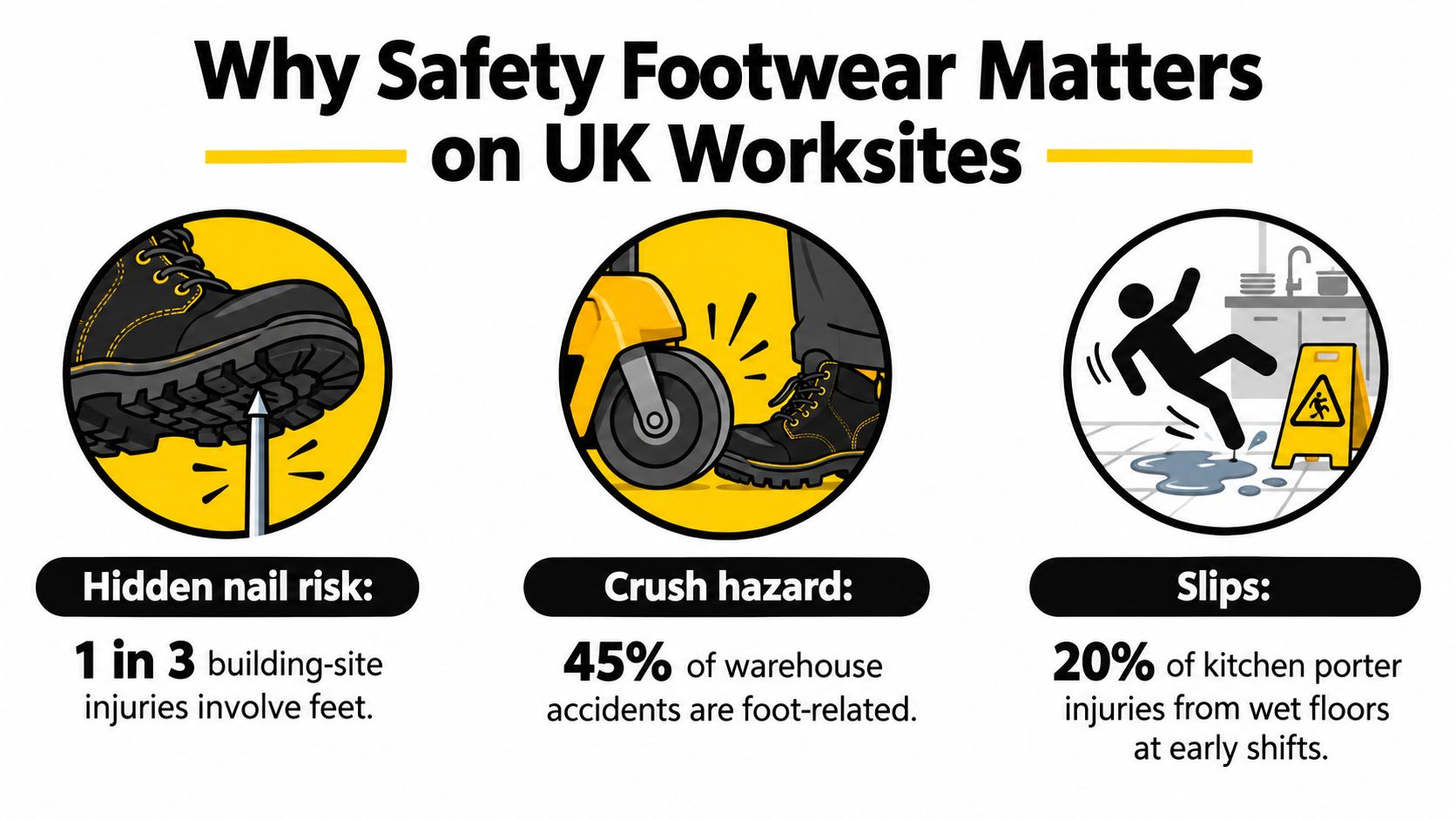
Start with the job rather than the colour or style.
The British Safety Industry Federation also reported that 88% of safety products tested from suppliers outside its Registered Safety Supplier Scheme failed against performance claims and/or supporting-documentation requirements. That finding is a historical warning for buyers. A boot that looks rugged isn't enough. The marking, certificate information and supplier documentation need to support the product's stated protection.
Practical rule: Treat safety footwear like any other item of PPE. Identify the hazard first, then verify the class and markings.
Safety footwear is PPE designed to protect the wearer from identified workplace risks. In the UK, the main technical reference for new safety footwear is BS EN ISO 20345:2022, the British implementation of EN ISO 20345:2022. It replaced BS EN ISO 20345:2011, which was scheduled for withdrawal on 31 March 2023, and formalises classes including SB, S1, S2, S3, S4, S5, S6 and S7. The published BS EN ISO 20345:2022 document sets the technical benchmark buyers should use when comparing products.
The standard covers more than a toe cap. It addresses mechanical risks, slip resistance, thermal risks, ergonomic behaviour, water vapour performance, abrasion and resistance to bumps, crushing and sharp objects. General-purpose safety footwear must provide a minimum 200-joule toe protection requirement, so a product described as a work shoe isn't automatically safety footwear.
A lightweight occupational shoe may be suitable for a role with limited hazards, but it shouldn't be assumed to offer certified toe or penetration protection. Wellies and rigger boots may be useful in wet or outdoor work, yet only products carrying the relevant safety certification and class should be selected where the risk assessment requires safety footwear.
Employers also have a legal responsibility to provide suitable protective footwear where foot-injury risk can't be controlled another way. The Personal Protective Equipment at Work Regulations 1992 are part of the UK workplace framework described alongside the standard. In practice, the employer must identify the risk, select suitable PPE and ensure workers can use it correctly.
Footwear is only one part of a safe floor and access strategy. For related premises decisions, the stair safety tread selection guide can help facilities teams think about how surface grip, location and pedestrian use affect stair safety.
The class on the label gives you a starting point, not a complete buying decision. Each class combines required features, so the right choice depends on whether the wearer works on dry concrete, wet tiles, muddy ground, sharp debris or another specific surface.
| Class | Toe Cap | Closed Heel | Anti-static | Water Resistance | Penetration-Resistant Midsole | Typical UK Use |
|---|---|---|---|---|---|---|
| SB | Required | Not necessarily | Not necessarily | Not necessarily | Not necessarily | Basic toe-protection environments |
| S1 | Required | Yes | Yes | Not necessarily | Not necessarily | Dry indoor work and warehouses |
| S2 | Required | Yes | Yes | Water-resistant upper | Not necessarily | Damp indoor or lighter outdoor work |
| S3 | Required | Yes | Yes | Water-resistant upper | Yes | Construction and mixed outdoor work |
| S4 | Required | Yes | Yes | Waterproof boot construction | Not necessarily | Wet indoor or outdoor duties |
| S5 | Required | Yes | Yes | Waterproof boot construction | Yes | Wet ground with penetration risk |
| S6 | Required | Yes | Yes | Waterproof footwear performance | Not necessarily | Wet working conditions |
| S7 | Required | Yes | Yes | Waterproof footwear performance | Yes | Wet, uneven ground with penetration risk |
The uvex explanation of safety-footwear standards describes the 2022 classification as eight main categories. S1 adds features such as a closed heel, antistatic behaviour and heel energy absorption. S2 builds on that with water-resistant uppers, while S3 adds penetration resistance and an outsole suited to more demanding underfoot conditions.
S4 and S5 refer to waterproof rubber or polymer footwear, with S5 adding penetration-resistant protection. S6 and S7 extend waterproof performance to footwear constructions covered by the newer classification. S7 is therefore relevant to outdoor work where wet conditions and sharp hazards occur together, but it still needs to suit the actual job.
SR indicates an additional slip-resistance requirement under the revised standard. Don't treat it as a promise that a boot will grip every contaminated floor. Slip performance depends on the test conditions, sole compound, tread, contamination and the surface underfoot.
You may also see ESD for electrostatic discharge control, CI for cold insulation and HRO for resistance of the outsole to hot contact. Penetration markings can distinguish metallic and non-metallic inserts, so check the product documentation rather than assuming every midsole offers identical protection.
The ISO overview of ISO 20345 confirms that the standard includes mechanical and thermal risks, slip resistance and ergonomic behaviour. That's why a higher-looking class isn't automatically the right answer. A dry warehouse operative may need a different balance of flexibility and breathability from a groundworker dealing with wet, contaminated soil.
Materials change how a boot behaves during a shift. They affect moisture management, flexibility, weight, cleaning and the way the sole meets the floor. The most suitable option depends on the work environment rather than on a material being universally superior.
Full-grain leather is a familiar choice for construction and outdoor work because it offers a substantial upper and can be maintained with appropriate cleaning and conditioning. Nubuck has a textured finish that many buyers prefer for appearance and feel, but it needs care to prevent dirt and moisture from damaging the surface. Microfibre can provide a lighter, easier-to-clean alternative, while PVC and rubber are common choices where waterproof boot construction and straightforward cleaning matter.
| Scenario | Upper | Sole | Toe cap | Midsole |
|---|---|---|---|---|
| Warehouse on dry concrete | Leather, nubuck or microfibre | Flexible PU or dual-density PU | Steel, aluminium or composite | Not always required |
| Outdoor construction | Full-grain leather or durable microfibre | Rubber, TPU or tough dual-density PU | Steel or composite | Steel or non-metallic penetration-resistant insert |
| Commercial kitchen | Easy-clean microfibre, PVC or rubber | Slip-focused rubber or polymer compound | Composite or metal, if required | Select according to the site risk assessment |
| Cold-store work | Suitable insulated upper or lining | Compound that remains suitable in cold conditions | Composite or metal, depending on specification | Select for the identified penetration risk |
Single-density PU can feel light and flexible. Dual-density PU combines different properties within the sole structure, while rubber and TPU can offer a tougher surface for demanding environments. The tread pattern matters as much as the compound. Deep channels may help move water and debris away, but a heavily lugged sole isn't automatically ideal on a smooth indoor floor.
Steel toe caps are familiar. Aluminium can reduce weight, while composite caps avoid metal and may be useful where non-metallic footwear is required. Composite doesn't mean uncertified, but the individual product still needs the relevant EN ISO 20345 marking.
Midsole choice also deserves attention. Steel inserts provide a traditional barrier against sharp objects, whereas non-metallic inserts can support a metal-free specification and may feel more flexible. For electronics roles, ESD requirements should come from the risk assessment. Cold-store work may require CI-related performance, but that marking must be checked on the product rather than inferred from a thick-looking lining.
A certified boot can still be the wrong purchase if it pinches, slips or leaves the foot unsupported. Check length and width together, because two people wearing the same UK size may need very different lasts. Brand conversion charts matter too. A UK size 7 may be shown as EU 41 in one chart, but you should always verify the specific manufacturer's guidance.
Measure both feet while standing, preferably later in the day when feet may be at their largest. Wear the socks intended for work, and leave enough room for natural movement without allowing the foot to slide inside the boot.
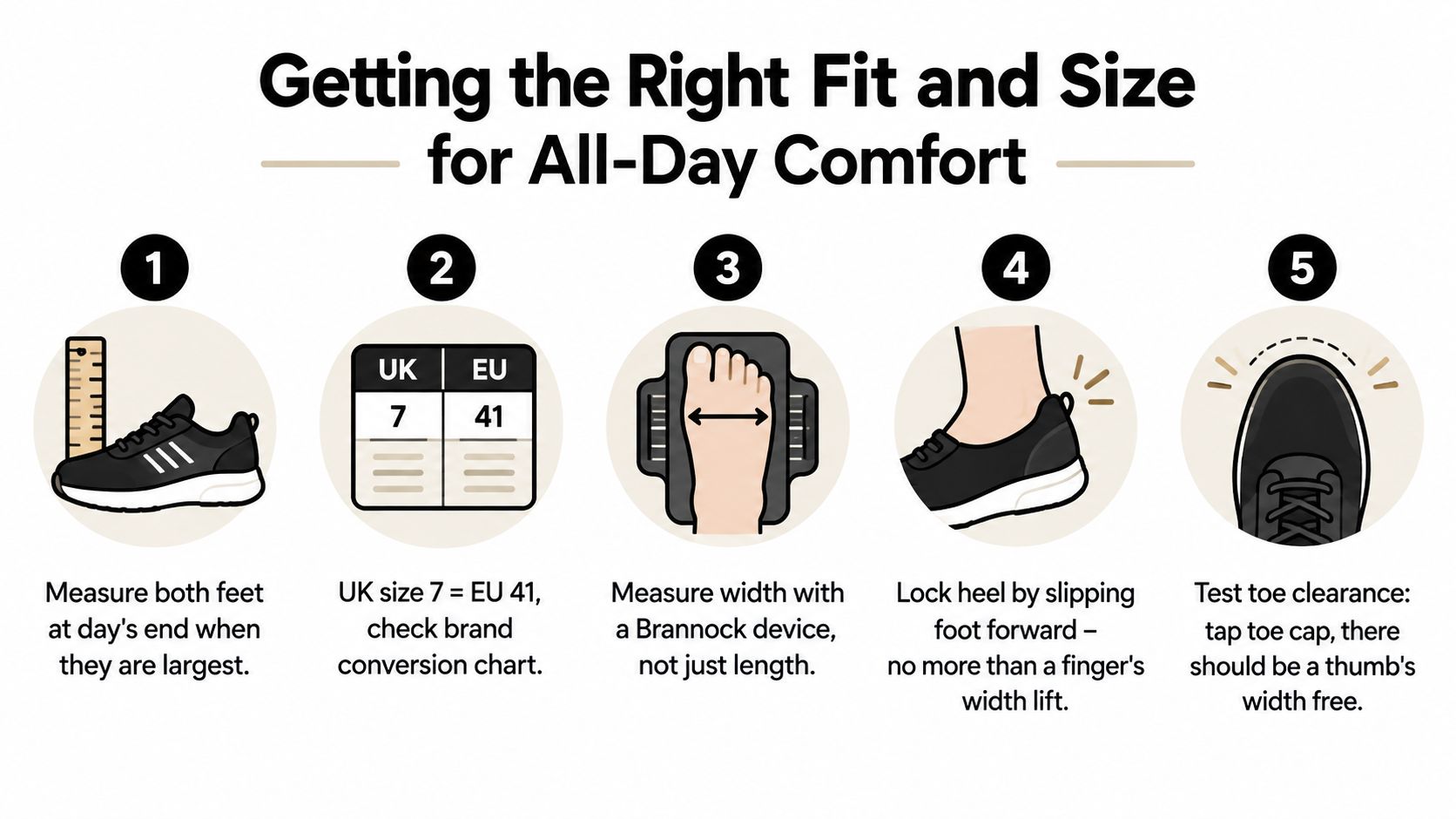
Stand up, walk, climb a step and bend the ankle. The heel should stay controlled when the boot is laced or fastened, while the toes shouldn't press into the cap. Tap the front of the boot to check clearance, but don't use that test alone. A safety toe cap won't compress like a soft shoe, so pressure at the front can become painful quickly.
Watch for these warning signs:
Break in new leather gradually. Wear the boots for shorter periods first, keep the inside dry and stop if a pressure point develops. Don't rely on thick socks to rescue a poor fit, because they can create extra compression over the forefoot.
For more targeted sizing advice, see Peppervale's women's safety boots guide for wide feet. A practical fitting video can also help you observe the basic checks before ordering.
Fit check: If you can't walk, squat and climb comfortably in the pair before the shift starts, don't expect the boot to improve simply because the label shows the right safety class.
Working boots endure water, grit, repeated flexing, impacts and contamination. Their useful life depends on the job, how often they're worn, the construction and how well they're maintained, so a fixed replacement timetable would be misleading.
Brush away dried debris before it works into seams or tread channels. Wipe leather clean before it dries out, use a suitable reproofing product where the manufacturer permits it, and dry footwear at room temperature. Direct heat can damage uppers, adhesives, linings and waterproof components.
Set aside time for a proper check rather than judging boots by appearance alone.
Rotate pairs where practical. Allowing footwear to dry fully can help preserve the materials, while a spare pair can prevent a worker from starting a shift in damp boots. Insoles should also be checked, particularly if they've flattened, curled or altered the fit.
Electrical incidents, penetration incidents and significant chemical exposure require a cautious decision. Don't repair or continue using boots when the protective structure may have been compromised. Ask the manufacturer or a competent safety adviser if the damage isn't obvious, and record replacement decisions for workplace PPE.
Employers should begin with a suitable and sufficient risk assessment, not with a preferred boot style. The assessment needs to identify the foot hazards present, such as falling objects, sharp penetration, hot work, electrical risk, wet or oily surfaces and long periods of standing on hard floors.
The HSE advises employers to select slip-resistant footwear as part of that assessment because footwear is only one control measure and must match the specific slip hazards at the workplace. The HSE procurement guidance for slip-resistant footwear is useful when a team is comparing claims and deciding how footwear fits into wider controls such as cleaning, drainage, flooring and housekeeping.
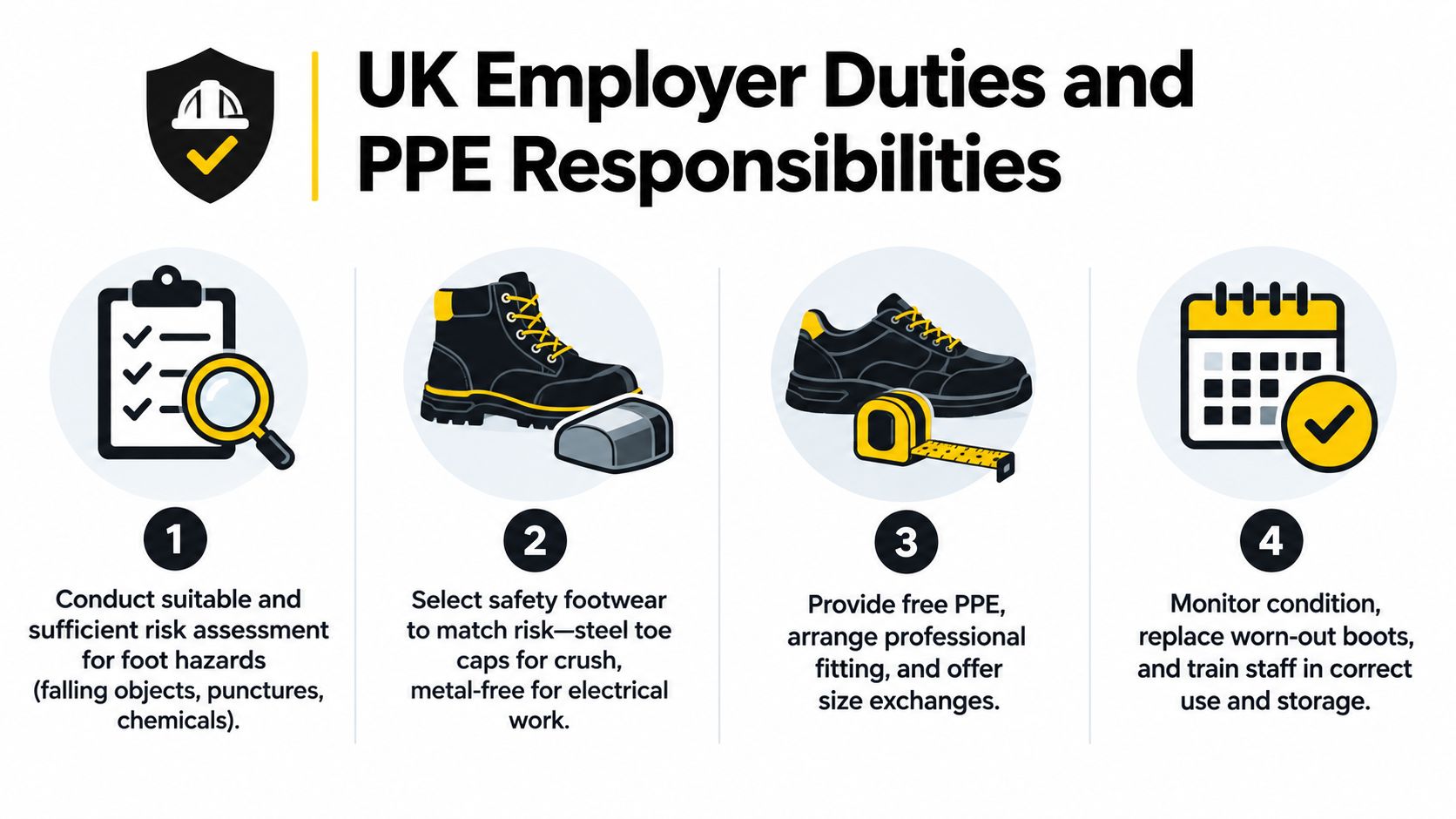
A good specification connects each hazard to a product requirement.
PPE must be supplied free of charge to employees where the employer requires it. The footwear should fit the wearer, remain compatible with other PPE and be maintained in good working order. Managers should explain why the footwear matters, how to clean and store it, and when to report damage.
Keep records of issue, instruction, inspections and replacement. Those records help demonstrate that the employer has managed PPE actively rather than handing out boots once and assuming the task is complete.
Hi-vis clothing often sits alongside safety footwear on the same site. Peppervale's UK hi-vis workwear guide provides related guidance for selecting visible workwear without confusing visibility requirements with foot protection.
Employer check: A compliant product is only part of the duty. The organisation must also provide the right size, explain correct use and replace footwear when it no longer protects.
Before comparing colours, brands or prices, write down the hazards the wearer will meet. Then check the EN ISO 20345 class, slip marking, toe-cap specification, penetration protection, water performance and any need for ESD, cold insulation or hot-contact resistance. Look for UKCA marking where applicable to the product and supply route, and retain batch or product information so the purchase can be traced.
Don't assume an older label is automatically illegal. Products certified to EN ISO 20345:2011 can remain on sale and in use until certificate expiry, potentially as late as 2029, while newer products may carry the 2022+A1:2024 version, as explained in uvex's guide to EN ISO 20345:2022. Check the certificate and expiry details rather than rejecting or accepting stock based only on the year printed on the box.
Does SR mean the boot can't slip?
No. SR refers to an additional test requirement. The actual floor, contamination, cleaning regime, tread and walking behaviour still affect grip. “Oil resistant” also describes a limited property, not universal slip protection.
Are composite toe caps as strong as steel?
A composite toe cap can be certified when the product meets the relevant standard and class. Compare the complete product marking and documentation, not the material name alone.
Should I always choose S7?
No. S7 is intended for demanding wet conditions with substantial protection, but it may be unnecessary for a dry indoor role. Extra structure can affect weight, flexibility and comfort, so match the class to the hazard list.
Is old-standard stock acceptable?
It may be, if the certificate remains valid and the product is suitable for the assessed risk. The newest standard isn't automatically the best choice for every job.
Where should I start comparing products?
Use a searchable safety footwear catalogue such as Peppervale's footwear and workwear range to narrow options by the information shown on live product pages, then verify the exact class, size and markings before purchase. The related men's UK workwear guide can help when safety footwear forms part of a wider workwear order.
Peppervale brings workwear and footwear together with other practical categories, so you can compare current options while keeping the required safety class and fit at the centre of the decision. Visit Peppervale to browse the live catalogue and build a shortlist suited to your job.


