Share:

- Women
- Men
- Kids & Baby
- Workwear
- Footwear
- Accessories
- Home & Living
- Health & Beauty
- Pet Supplies

You've got the van keys in one hand, a coffee in the other, and a quick look at the weather says rain by lunchtime. The problem is familiar enough. Do you wear the smart trousers that look right for the office, the tougher pair for the site, or a jacket that won't leave you soaked on the commute?
That decision sits at the heart of mens workwear UK shopping. It isn't one neat category. It's a spectrum that runs from office-friendly layers and smart-casual pieces to protective kit built for hazards, wet weather and long shifts. For UK shoppers, that matters because the right choice depends on the job, the season and whether the garment needs to meet a safety rule as well as a dress code.
This guide breaks that down in plain English. You'll see how to separate workwear from officewear and smart-casual, how to spot the standards that matter, how to think about fabric and fit, and how to look after kit so it lasts. The aim is simple, to help you buy once, wear well and avoid the common mistake of choosing something that looks right but doesn't suit the work.
A lot of people start with the wrong question. They ask, “What is the best work shirt?” when the right question is, “What does this job ask the clothing to do?” A warehouse picker, a delivery driver and a site supervisor may all want something presentable, but their clothing needs aren't the same. One needs movement and durability, another needs weather protection, and another may need high visibility or safety footwear as well.
That's why mens workwear is best thought of as a toolkit. Some pieces are there for comfort, like soft layers for a cold depot or a long commute. Others are there for visibility, grip, protection from the weather or protection from specific hazards. Officewear sits at the softer end of that spectrum, smart-casual fills the gap, and true workwear begins where function and compliance take priority over appearance alone.
The market context helps explain why the category keeps growing. The UK menswear market was valued at USD 21,585.76 million in 2025 and is projected to reach USD 32,485.23 million by 2034, with a 4.65% CAGR from 2026 to 2034 (MarketsandMarkets). A separate UK retail insight also found that 72% of employees buy clothes specifically for the office, 40% keep a dedicated work-only wardrobe, and men spend more on office outfits on average than women, at £141 vs £99 (MarketsandMarkets). That tells you the line between work and everyday dressing is still a live one in the UK.
Practical rule: if the garment has to protect you from a hazard, don't judge it by how it looks on a hanger. Start with the job, then check the label.
If you've ever wondered whether a quarter-zip is smart-casual or acceptable for a hybrid workplace, you're not alone. The blurred middle ground is exactly where most shoppers hesitate, and it's why the rest of this guide focuses on matching category, fit and compliance to real-world use.
The easiest way to think about workwear is to separate weather protection, hazard protection and wear-and-tear protection. A waterproof shell is like a raincoat for the job. High-visibility clothing is more like a visual signal. Safety footwear is the sturdy base that keeps you moving when floors, tools or loads create risk.
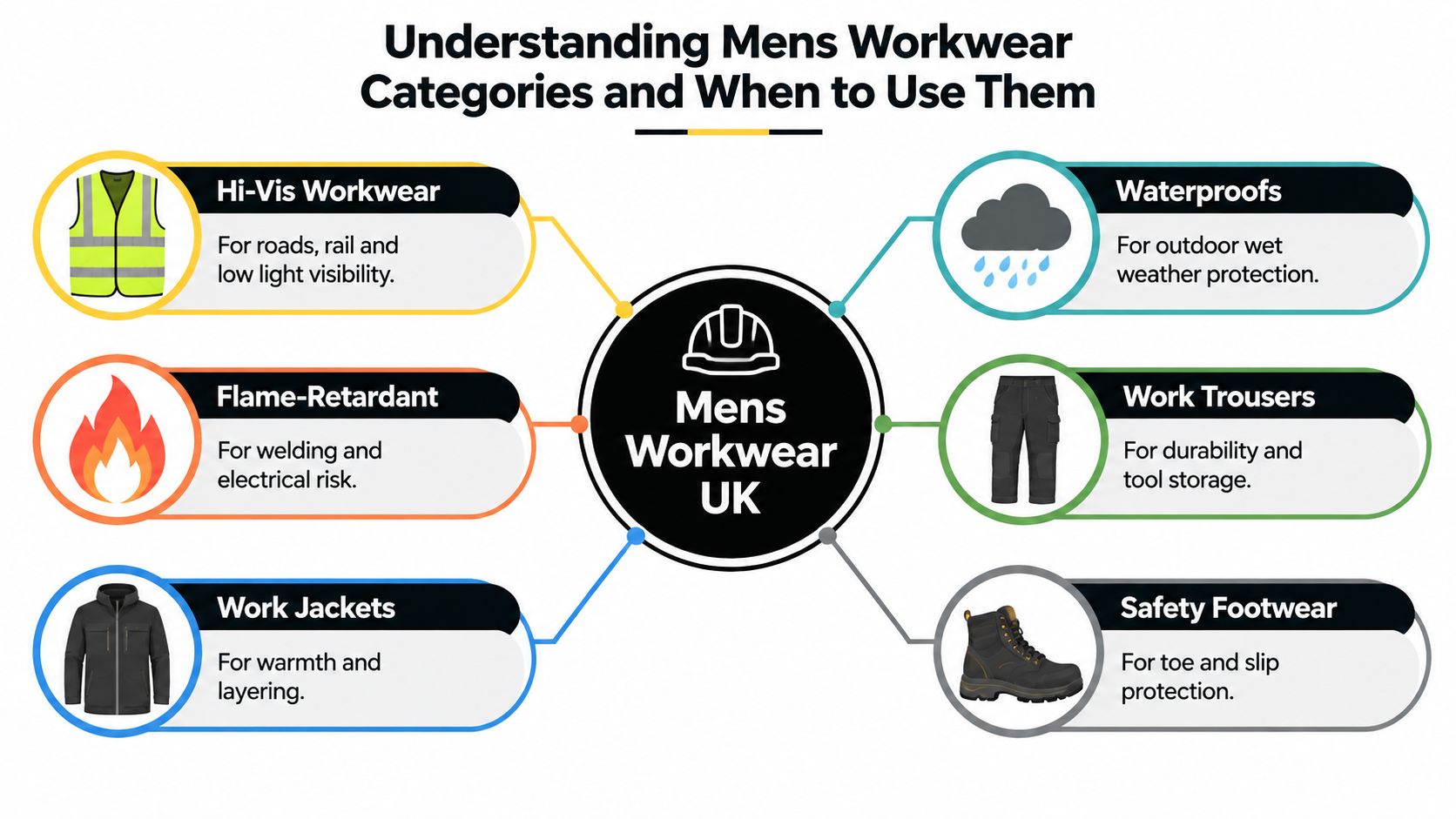
If someone works near traffic, rail, plant or low light, hi-vis is about being seen first and looking smart second. If they spend the day outdoors, waterproofs matter because wet clothes slow people down and make every movement less comfortable. If they weld, handle sparks or work around electrical risk, flame-retardant clothing belongs in a different conversation altogether.
For sites, warehouses and trade counters, the everyday workhorses are usually work trousers, jackets, shirts, knitwear and safety footwear. These sit at the practical end of the scale. They need to handle kneeling, lifting, driving, repeated washing and the sort of scrapes that happen when you're carrying tools through a narrow corridor or climbing in and out of a van.
That's also where the overlap with smart-casual and officewear causes confusion. A dark overshirt, a gilet or a quarter-zip may look acceptable in a hybrid office, but that doesn't make it suitable for a site with safety requirements. The garment might fit the dress code, yet fail the protection test. That's why the same item can be fine for a showroom, questionable for a warehouse and completely wrong for roadside work.
A useful way to sort the range is this.
If you want a useful external example of how contractor kit is often grouped by job type, Dirt Cheap Product contractor gear is a simple illustration of how trade clothing gets organised around use rather than fashion.
For roadside jobs, a dedicated guide like what hi-vis do I need for roadside work is worth reading before you buy, because visibility needs vary with the environment and the task.
Don't buy the label that sounds toughest. Buy the item that matches the risk, the weather and the movement your day actually involves.
Once you've named the category correctly, the shopping gets easier. You're no longer comparing random jackets and trousers. You're choosing between garments that serve different jobs.
This is the part many shoppers skip, then regret later. If workwear is being used as personal protective equipment, it has to meet the legal requirements for PPE placed on the Great Britain market, which means most new items must be UKCA or CE marked, supplied with a declaration of conformity, and accompanied by English instructions (HSE). Employers also have to supply suitable PPE where a risk assessment shows it's needed (HSE). In other words, a garment that looks like workwear isn't automatically compliant workwear.
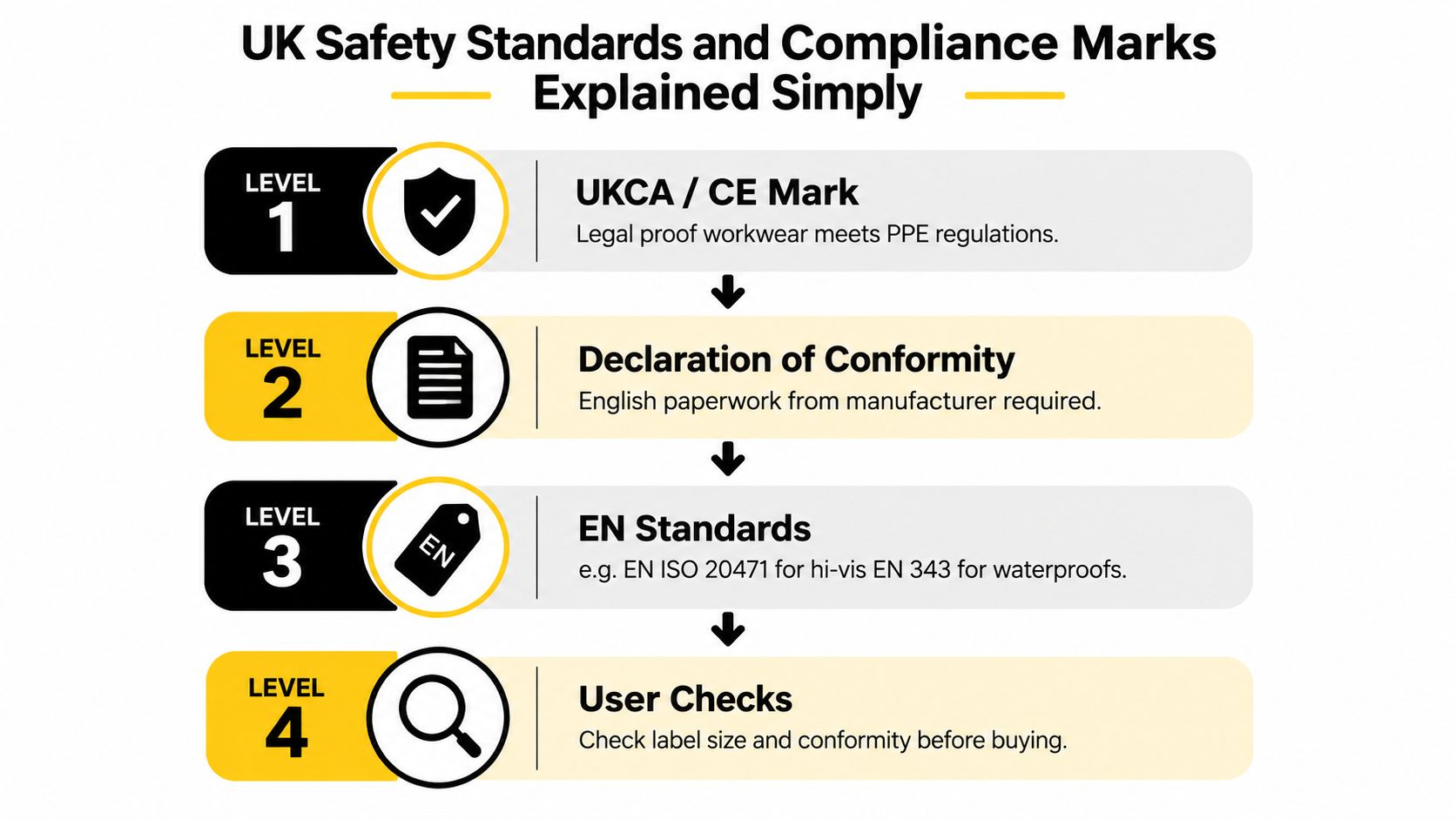
Start with the mark, then the standard, then the user checks. That order matters because fabric weight alone tells you very little. A heavy-looking garment can still be the wrong one if it isn't certified for the hazard you're dealing with.
For high-visibility clothing, HSE identifies BS EN 471 as the British Standard for high-visibility warning clothing and notes that since July 1995 new clothing must be CE marked to show it meets the PPE manufacturing rules (HSE). The practical point is straightforward. Fluorescent colour and retro-reflective tape are governed by standardised requirements, so a garment that merely looks bright isn't enough if the task calls for compliant hi-vis.
Safety footwear is similar. In the UK, the principal benchmark is BS EN ISO 20345, and many site rules treat it as the minimum standard for protective footwear, with a 200J toe-cap protection requirement as a minimum (Arco). If you're buying for a site role, the shoe's appearance matters far less than the standard printed in the spec.
For foot protection, employers in the UK must provide suitable personal protective equipment, including safety footwear, free of charge where a risk assessment shows foot hazards can't be controlled by other means. That requirement is tied to the Personal Protective Equipment at Work Regulations 1992, as amended in 2022 (Rockfall). That's important because the buying decision isn't always personal. In many jobs, it's part of a compliance process.
The cleanest approach is to ask three questions before purchase. Does the item need a legal mark, does it cite the correct EN standard, and does the listing show the paperwork and instructions that go with it? If the answer is unclear, treat it as a clothing item, not PPE, until proven otherwise.
The same logic applies whether you're buying for one person or a whole team. A site supervisor, a buyer and a wearer all need to know the same thing. If there's hazard exposure, the label has to prove the protection, not just suggest it.
For a footwear-focused example of how compliance gets translated into product choice, see choosing the right Crawford boot for site work.
Once the standard is right, the next question is how the kit feels after six or eight hours of actual use. That's where material choice makes a bigger difference than most shoppers expect. A garment can be fully appropriate on paper and still be miserable if it traps heat, restricts movement or feels scratchy when layered.
Cotton tends to feel familiar and breathable, which is why people like it for comfort. The trade-off is that it can hold moisture and may not bounce back as well after repeated hard use. Poly-cotton blends usually aim for a more practical balance, giving some of the comfort of cotton with extra resilience and easier care.
Ripstop fabrics are useful where snagging is likely, because the weave is designed to resist tears spreading. Softshell is often a good middle ground for active workers who need stretch, wind resistance and a cleaner silhouette for moving between van, site and office. Waterproof membranes do the obvious job of keeping water out, but a key difference is how well they manage breathability when you're active.
If you're comparing softer everyday fabrics with more technical ones, it helps to think about what sits against the skin. A breathable knit can feel far better under a jacket than a stiff outer layer. For readers interested in a deeper look at fabric feel, bamboo fabric clothing is a useful contrast point, even though workwear often needs tougher construction than casual clothing.
| Workwear Fabric and Feature Comparison for UK Conditions | Best For | Comfort and Durability Trade Off |
|---|---|---|
| Cotton | Everyday comfort and lighter-duty wear | Comfortable, but less resistant to hard wear and moisture |
| Poly-cotton | General trade and uniform use | Better balance of comfort, shape retention and washability |
| Ripstop | Snag-prone jobs and rougher environments | Lighter feel with improved tear resistance |
| Softshell | Active work, commuting and layering | Flexible and comfortable, but not always enough for heavy rain |
| Waterproof membrane | Wet outdoor work | Strong weather protection, with breathability depending on design |
| Reinforced knees | Kneeling and floor-level tasks | Adds bulk, but extends wear life where trousers fail first |
| Triple stitching | Heavy daily use | Better seam strength, usually at the cost of a stiffer feel |
| Taped seams | Rain protection | Improves weather resistance, but can reduce softness and airflow |
Reinforced knees matter because trousers usually fail where the body bends. Triple stitching helps because seams take repeated stress when you lift, squat or climb. Taped seams make a big difference in wet weather, and sole construction matters just as much in footwear because the tread and bond affect how long the shoe stays serviceable.
Simple test: if you can tell a garment will fail at the first bend, snag or downpour, it's the wrong one for a shift, no matter how good it looks on the rail.
The best choice is rarely the thickest or most technical-looking item. It's the one that fits the job, survives the wash and still moves well after the fiftieth wear.
Fit decides whether workwear helps you or gets in the way. A jacket that looks neat on a hanger can ride up when you reach overhead. Trousers that seem fine in the changing room can pull at the knee when you climb a ladder or sit in a van for half an hour. Comfort starts with the cut, but it's finished by how you layer underneath.
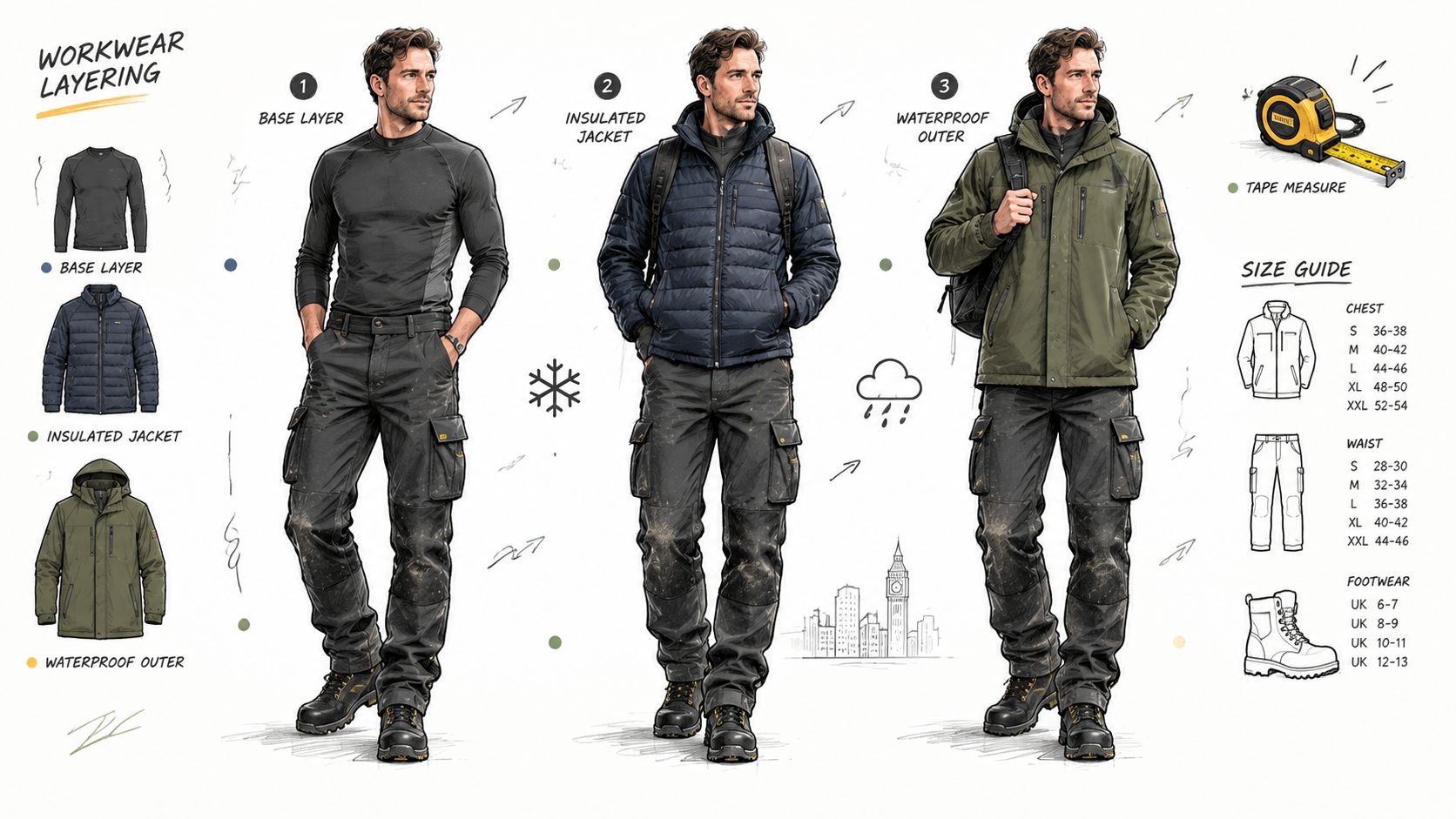
For jackets, check that you can lift your arms, reach across your chest and sit without the hem pulling too high. Sleeve length should cover the wrist when you're driving or working with your arms forward, not just when you're standing straight. For trousers, look for enough room in the thigh and seat to squat, kneel and drive without strain.
Safety footwear needs the same practical approach. Your foot shouldn't feel squeezed at the toe, and the heel shouldn't lift badly when you walk. If you're wearing thicker socks in winter, test them with the socks you'll use on site. A boot that feels fine barefoot in the shop can become tight after half a shift.
The simplest system is a base layer, an insulating middle layer and an outer shell. That works because each layer has one job. The base layer deals with comfort, the middle layer holds warmth, and the outer layer blocks wind and rain.
Commuting matters as much as the workday. A driver moving between depot, van and customer sites needs clothing that can come on and off without turning into a pile of bulky kit. A warehouse worker may want a lighter top under a jacket, while a site worker may need enough room for movement plus enough space for an extra fleece underneath in cold weather.
For readers who like to compare fit digitally before ordering, practical advice on virtual try-on is worth a look because it reinforces the same point. The goal isn't to chase a number on the label. It's to reduce guesswork and make sure the garment works in motion.
If you can't bend, drive, crouch and reach in it, the size is wrong, even if the tag says it's your usual one.
Use a simple try-on checklist. Raise your arms. Sit down. Walk a few steps. Bend at the knee. If the garment stays put, moves cleanly and doesn't pinch, you're close to the right fit.
A uniform that is looked after properly lasts longer, and it also keeps doing the job it was bought for. Workwear behaves more like kit in a toolbox than an ordinary weekend shirt. Hi-vis tape, waterproof coatings and safety footwear all wear in different ways, so the care routine has to match the item. If you treat everything the same, the clothing may still look tidy while the protection has already dropped away.
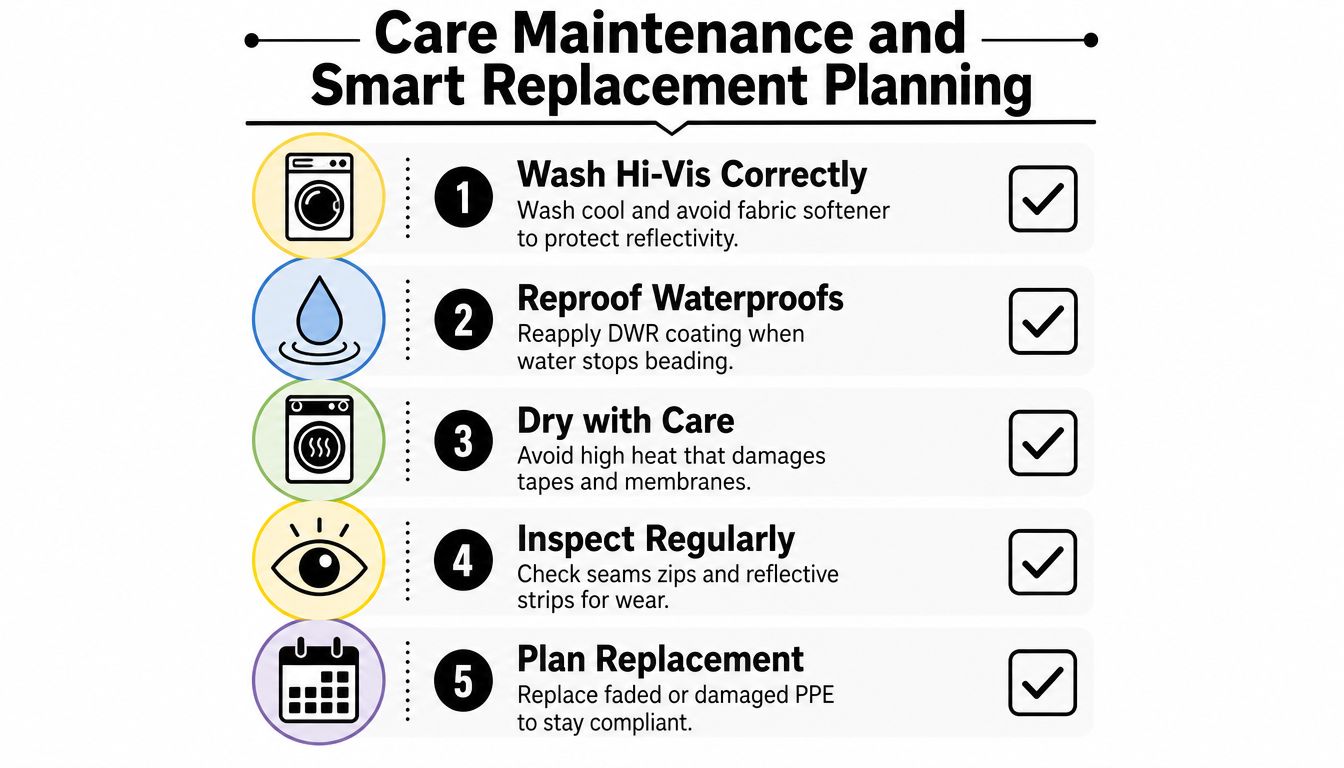
Hi-vis items should be washed exactly as the label says. That is because reflective tape and fluorescent fabric can lose performance if they are washed too hot, dried too hard, or treated with the wrong additives. Waterproof layers need the same careful handling. Heat can damage the membrane, and rough drying can weaken taped seams.
Once water stops beading on the surface, the waterproof finish usually needs attention. Reproofing can help restore that outer barrier. Safety footwear needs regular checks too. Look for worn soles, damaged uppers, loose stitching and anything that changes grip or support. If a boot starts to flex badly or the tread is getting thin, it is no longer doing the same job it did on day one.
Buying workwear is not just about picking a size and hoping for the best. It helps to match the category to the setting, the season and the level of protection needed. Officewear can sit closer to smart-casual, while site work and other compliance-led roles need clothing that is built and marked for the task. That distinction matters because a neat-looking jacket is not the same thing as kit that can handle rain, movement and long shifts.
For a clearer view of the wider market, workwear.co.uk notes that workwear apparel was the largest revenue-generating product segment in 2024, while workwear footwear was the fastest-growing segment over the forecast period. That is useful context for buyers, because garments and boots often wear out at different speeds. A jacket might still look fine while the soles on the boots have already reached the point where replacement makes more sense than repair.
Planning ahead also keeps downtime down. Keep a spare set where the job depends on it, especially if the item is part of a daily uniform. A manager's issue log helps here, because it shows when PPE was issued, checked and replaced. That makes stock control easier and avoids the awkward gap between an item failing and a replacement arriving.
Good habit: if the reflective strip is fading, the waterproofing has gone or the sole is breaking down, replace it before it stops doing its job.
Good shopping starts with a narrow question. Do you need office-smart layers, site-ready kit, safety footwear or something that bridges the commute and the workplace without looking out of place? Once you answer that, compare the live product details carefully, because workwear is one of those categories where a small difference in the listing can change how suitable the item is for your day.
The safest approach is to check the live page for the details that matter, then compare like with like. Look at the stated category, the size information, the listed features and any compliance marks before you order. If you're buying for a team, make the same checks for every item rather than assuming similar-looking garments perform the same way.
A few quick checks keep the process sane.
That's where Peppervale's broad catalogue is useful. It gives UK shoppers one place to compare practical clothing, footwear and related everyday categories without treating every search as the same kind of purchase. The value is in matching the item to the task, then verifying the live details before you click buy.
If you're ready to build a kit that fits the job, browse Peppervale for mens workwear, safety footwear and the everyday layers that sit between smart-casual and proper site protection. Check the live product details, choose the right standards, and pick the pieces that'll carry you through the shift and the commute with less guesswork.


