Share:

- Women
- Men
- Kids & Baby
- Workwear
- Footwear
- Accessories
- Home & Living
- Health & Beauty
- Pet Supplies

The bedroom felt comfortable at bedtime, but by midnight the duvet was pushed to the floor, the pillow felt warm, and the sheet had started to cling. In many UK homes, that pattern isn't limited to the occasional sunny weekend. During the hot summer of 2018, more than 4.6 million main bedrooms in England, 19% of the total, were judged to overheat, according to a 2026 Loughborough University analysis.
Good cooling bedding in the UK won't turn a bedroom into an air-conditioned space. It can, however, reduce heat and moisture trapped next to your body, which makes a meaningful difference when your room is stuffy, your mattress retains warmth, or a heavy duvet is no longer suitable. The right choice depends on the cause of the discomfort, not just the word “cooling” on a product label.
A warm bedroom creates a difficult compromise. You want enough cover to feel settled, yet every extra layer can hold more heat against your skin. Removing everything may leave you uncomfortable, while a winter duvet can make you feel enclosed and clammy.
The scale of the problem matters. The Loughborough analysis found that more than 4.6 million English main bedrooms overheated during the hot summer of 2018, representing 19% of bedrooms. That makes cooling bedding a practical home-comfort category, rather than a niche upgrade for unusually warm sleepers. You can also compare everyday sheet choices in this guide to the best sheets for hot sleepers.
Bedding works inside the room you already have. If sunlight warms the room throughout the afternoon, windows stay closed all evening, or a memory-foam mattress and thick protector hold heat beneath you, changing the duvet cover alone may not solve the problem.
Research linked to UK comfort guidance points to keeping bedroom temperatures at 26°C or less to reduce overheating risk, while the smaller sleep microclimate beneath bedclothes may feel more comfortable around 29°C to 31°C. Those figures describe different spaces. The room needs to avoid excessive heat, while bedding needs to manage the warmth and moisture produced around your body.
Practical rule: Choose bedding that lets you adjust coverage. A breathable sheet, a lighter duvet and a removable layer give you more control than one thick, highly insulating setup.
Cooling bedding is most useful when the bed itself is the problem. If the whole room remains hot for hours, combine breathable layers with shading, ventilation and sensible fan use. Bedding can improve the immediate area around your body, but it can't remove heat from the walls, ceiling or air.
Cooling bedding means passive temperature management. It doesn't actively refrigerate you. Instead, suitable fabrics, weaves, fills and layers help air move, allow moisture to evaporate and reduce the amount of heat held close to your body.
Three properties matter most:
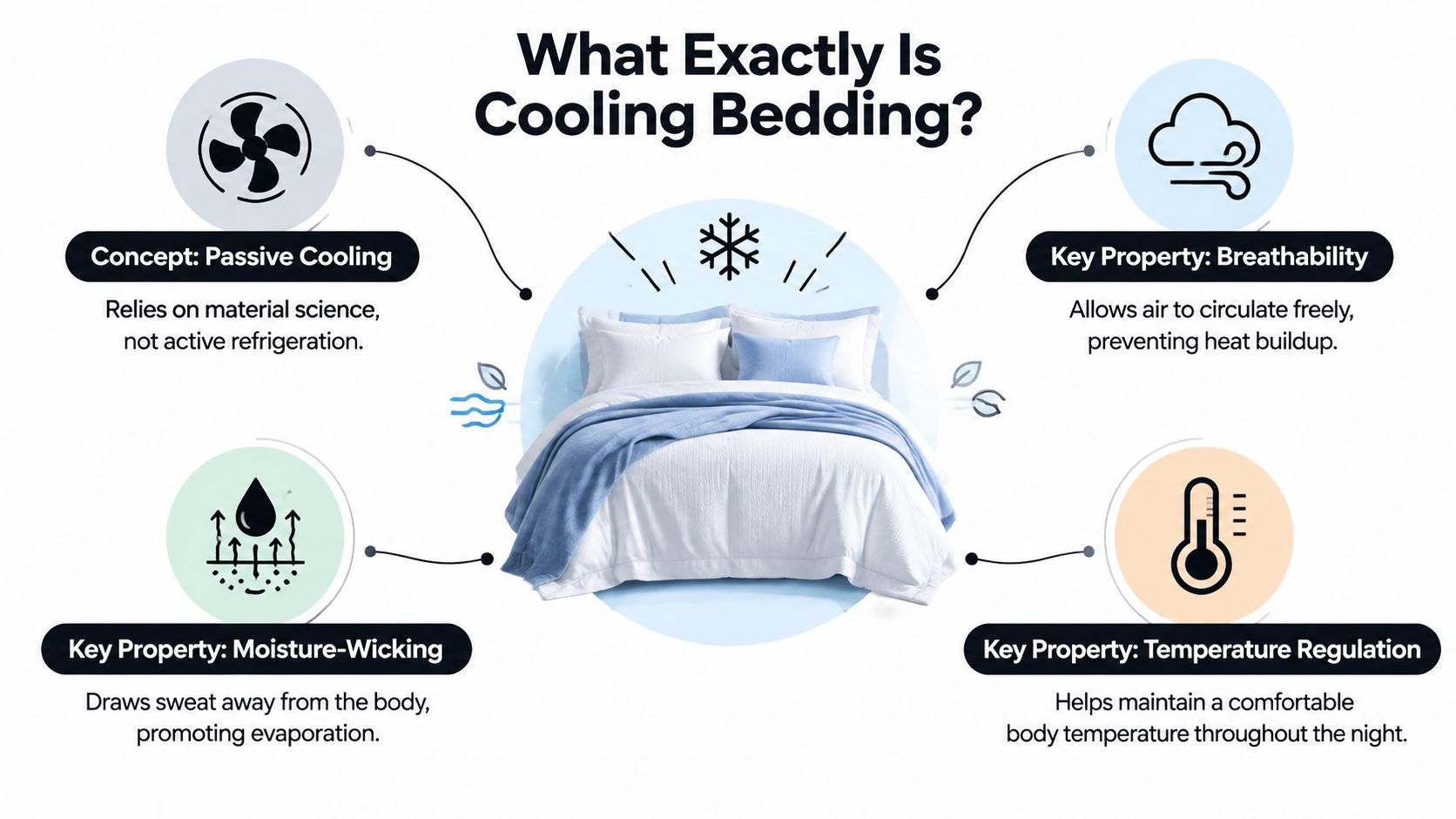
Public polling found that 65% of UK adults struggled to sleep during a recent heatwave, while 35% spent extra money on fans or other cooling measures, as reported by Greenpeace UK's survey coverage. That response reflects a straightforward household need. People aren't necessarily looking for a cold bed. They want to stop heat and dampness building up while they sleep.
A fabric can feel cool when you first touch it and still become uncomfortable after several hours. Initial coolness is only one part of the experience. If a material has limited airflow or holds moisture against the body, it may feel warm and sticky later in the night.
The weave also changes how a fibre performs. A loose, airy construction may feel fresher than a dense, smooth fabric made from a similar fibre. That's why a material name alone doesn't tell you everything. Check the fabric composition, weave description and care instructions on the product page.
Some shoppers expect cooling bedding to feel chilled throughout the night. Most passive options don't work that way, and they shouldn't need to. The useful result is a more even sleep microclimate, with less heat retention and fewer damp patches.
Synthetic performance fabrics can suit some sleepers, particularly when quick drying is important, but they're not automatically the best choice. Natural fibres such as linen, cotton and wool can offer strong breathability or moisture management, depending on construction and personal preference.
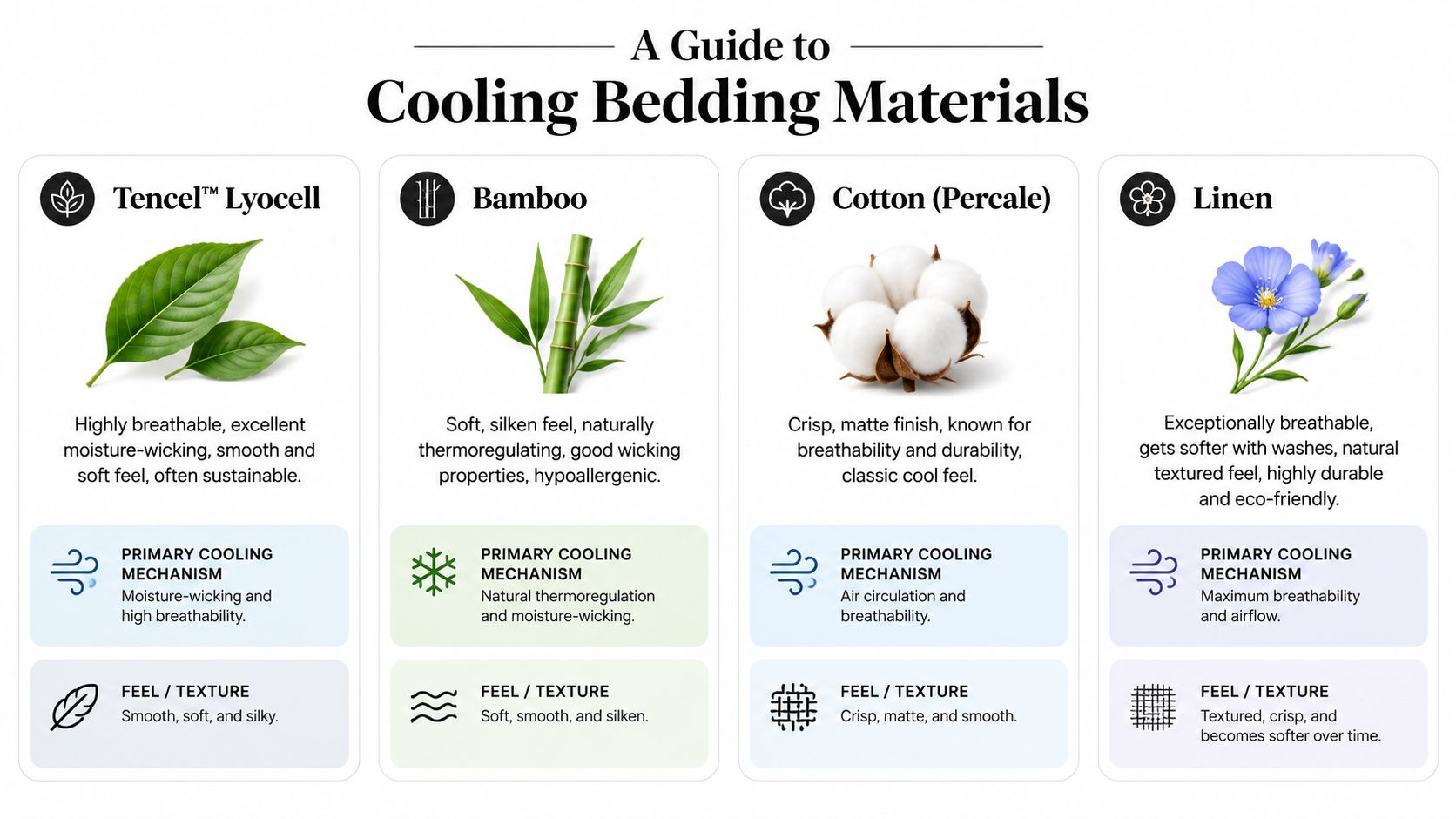
Material choice changes the feel of the bed more than many shoppers expect. Linen tends to feel textured and relaxed, percale cotton feels crisp, and smoother regenerated fibres can feel soft against the skin. None is universally right, because sleepers differ in how much texture, drape and moisture absorption they prefer.
| Material | Cooling strengths | Feel | Points to consider |
|---|---|---|---|
| Linen | Strong airflow and moisture handling | Textured and relaxed | Can feel crisp at first and usually needs careful washing |
| Percale cotton | Airy weave and crisp surface | Cool, matte and fresh | May feel less silky than sateen |
| Bamboo viscose | Soft handle and moisture management | Smooth and silky | Check the actual composition and care label |
| Tencel™ lyocell | Breathable, smooth and moisture-aware | Soft and fluid | Follow the product's washing instructions |
| Wool | Effective moisture transfer and temperature moderation | Springy and insulating | Better suited to shoppers who like a warmer, natural hand |
Linen is a strong option for a bedroom that feels stuffy. Its natural texture creates an easygoing finish, and it generally becomes softer with washing. It doesn't feel polished and silky in the way some shoppers expect from “luxury” bedding, so choose it for airflow and character rather than a slippery surface.
Percale cotton uses a simple, crisp construction that many people associate with hotel bedding. It feels matte rather than glossy and can be a good everyday choice if you want a fresh surface without the texture of linen. It's also a sensible starting point when you want breathable bedding but prefer a familiar cotton feel.
Bamboo viscose is often chosen for its smooth, soft handle. It can feel comfortable against the skin and may suit sleepers who dislike crisp cotton. Before buying, read the fibre description carefully, because “bamboo” can refer to a processed viscose rather than a raw bamboo fibre. Our comparison of bamboo sheets versus cotton covers the practical differences shoppers tend to notice.
Tencel™ lyocell has a smooth, fluid feel and is commonly selected for its moisture-management characteristics. It may suit people who want a softer surface than percale, but it can require more careful laundering than durable cotton. Treat the stated composition and care label as the authority for each individual product.
Wool deserves attention because cooling doesn't always mean thin or synthetic. UK evidence found that wool bedding transferred 43% more moisture than polyester and 67% more than feather and down duvets over an 8-hour sleep period, according to research held by Loughborough University. The finding shows why fibre choice affects the moisture conditions beneath the covers, although wool's natural loft may still feel too warm for someone who wants a very light summer layer.
Choose the surface you'll actually enjoy sleeping on. A technically breathable fabric won't help if its texture makes you over-layer or avoid using it.
Build the bed from the layer closest to your body outwards. This approach prevents an attractive duvet cover from masking a heat-retaining mattress protector, pillow or duvet filling.
An NHS sleep-hygiene leaflet from Sandwell and West Birmingham NHS Trust gives an ideal sleep temperature range of 18°C to 24°C, as set out in its sleep-hygiene advice. Measure your bedroom at night rather than relying on the outside forecast. A room that cools quickly after sunset needs a different setup from a loft room that stays warm until morning.
Match the duvet's tog rating to that usual indoor temperature. A lighter duvet or separate cover gives you flexibility, while an unnecessarily heavy all-year layer can retain warmth when you don't need it. Don't assume a “summer” label guarantees comfort. Product construction, filling and your own sleeping preference still matter.
The fitted sheet sits directly against you, so it often has more influence than a decorative top layer. Choose linen if you like a naturally textured feel and strong ventilation, percale cotton if you prefer crispness, or a smoother option if you dislike rougher surfaces.
Fit matters too. A sheet that pulls loose, bunches or leaves too much fabric trapped beneath you won't feel as comfortable as a properly sized one. Check the mattress dimensions, including depth where relevant, especially if you use a topper.
A mattress protector can sit between your body and the mattress, making its surface and construction important. Look for clear fibre information rather than assuming every protector is breathable. The same applies to pillow protectors and pillowcases. Your head and neck produce warmth and moisture, so a dense or heat-retaining pillow combination can undermine otherwise airy sheets.
If your mattress itself stays hot, a bed-level intervention may be more useful than changing decorative bedding. Loughborough University research on a cooling mattress topper found improved thermal comfort in an overheated 30°C bedroom, alongside 19 additional minutes of sleep and a reduction of 10 minutes in time taken to fall asleep, as reported in Good Housekeeping's coverage of the bed-cooling research. These results relate to that tested setup, not a guarantee for every home or product.
Watch the practical buying advice before you choose your layers:
Children need bedding matched to the room and their sleepwear, not necessarily the lightest possible option. South Tees Hospitals NHS Foundation Trust guidance gives 2.5 tog for standard rooms of 16°C to 20°C, 1.0 tog for rooms of 20°C to 24°C, and 0.5 tog for warmer rooms of 24°C to 27°C in its baby sleepwear and sleeping-bag guidance, reproduced in this UK tog guide. Follow the child-specific safety guidance that applies to your situation, and check the room temperature rather than guessing.
Cooling bedding only performs well when it stays clean, dry and correctly fitted. Moisture, body oils and detergent residue can build up over time, making fabric feel less fresh and reducing the pleasant hand you noticed when it was new.
Read the care label before washing. Linen may soften with regular laundering but can crease, while some regenerated fibres need gentler cycles or lower temperatures. Avoid adding fabric softener automatically, as it can alter the feel and absorbency of some fabrics. Dry bedding fully before putting it back on the bed, especially in damp UK weather.
Use this short checklist:
Product pages should answer these questions before you buy. If the composition isn't clear, treat that as a reason to pause rather than filling in the gaps yourself. Peppervale's UK bedding sets guide can help you think through set contents and sizing while you compare available home products.
For a temporary hot spell, you may not need to replace every layer. Start by removing the heaviest duvet, using the most breathable sheet you already own and checking whether the protector or topper is trapping warmth. If the room remains hot for many hours, close blinds or curtains during the sunniest part of the day and ventilate when outside air is cooler.
Government-backed monitoring found bedrooms were above 26°C for an average of 54 minutes per day in summer 2025, increasing to 4.7 hours on nights after heatwave days, according to the Homes for Net Zero summer 2025 findings. That distinction matters. Bedding can improve the bed-level microclimate, but it can't compensate for a room that stays excessively hot deep into the night.
The best cooling bedding setup is the one that matches your actual bedroom and your preferred feel. A stuffy new-build bedroom may need breathable sheets plus better daytime shading and ventilation. A memory-foam bed may benefit more from a suitable topper or protector, while a temporary heatwave may only require lighter coverage and a washable, airy sheet.
Choose in this order: assess the room, select the surface fabric, reduce unnecessary insulation, then inspect the mattress and pillow layers. Linen and percale cotton suit shoppers who value airflow and a natural or crisp feel. Bamboo viscose and Tencel™ lyocell may appeal if you prefer a smoother surface. Wool can manage moisture effectively, but its loft and warmth won't suit everyone.
Don't judge a product solely by a “cooling” claim. Check the composition, weave, filling, care instructions and dimensions, then consider whether your problem is sweat, heat retained by the mattress, an overly warm duvet or a room that needs cooling beyond the bed. That decision will save you from buying an expensive set that addresses the wrong source of discomfort.
Peppervale's catalogue includes home and living products alongside clothing, footwear, workwear, family essentials, accessories, health and beauty and pet supplies, so shoppers can compare practical household purchases in one place. Product details can change, so use the relevant live page to confirm what each current item includes before ordering.
Explore the current Peppervale home and living selection to compare bedding and other practical household products for a more comfortable sleep setup. Choose the layers that suit your room temperature, preferred fabric feel and budget, then check the live product details before you buy.


