Share:

- Women
- Men
- Kids & Baby
- Workwear
- Footwear
- Accessories
- Home & Living
- Health & Beauty
- Pet Supplies

You pull on a pair of leggings that looked perfectly fine in the bedroom mirror. Then you bend to tie a trainer, crouch at the school gates, or drop into a squat at the gym and suddenly you're wondering what everyone else can see.
That's why women's leggings not see through isn't a fussy shopping preference. It's a practical requirement. If leggings are going to work for errands, exercise, working from home, travel, or everyday layering, they need to stay opaque when the fabric is under real tension, not just when you're standing still.
Most confusion starts here: people assume opacity is mainly about thick fabric. It isn't. Thickness helps, but the issue is how the knit behaves when it stretches across your body. Once you understand that, it becomes much easier to shop sensibly, test new pairs at home, and spot trouble before your favourite leggings become the pair you only wear under a long jumper.
In Britain, this problem hasn't gone away just because brands now use terms like “opaque” or “squat-proof”. Shoppers still end up with leggings that look respectable on the hanger and disappointing in motion.
A recent UK-relevant sign of why this matters is a YouGov survey of 4,412 GB adults conducted on 13 March 2025, which asked about transparent or translucent clothing in public. The question wasn't limited to leggings, but it shows that visible skin or underwear through clothing is still a live issue in Britain, not an outdated fashion worry (opacity guide discussing the survey).
This isn't just about aesthetics. It affects whether you feel comfortable picking up a toddler, climbing stairs at work, or joining a class without second-guessing your outfit.
British settings can make the problem worse:
Opaque leggings need to work in motion, under light, and in your actual size.
A useful contrarian point often gets missed. Opacity failure is usually a stretch problem, not just a thickness problem. Independent analysis notes that fabric can look opaque laid flat, then go sheer once it's stretched at the seat or thigh. The same piece also notes that “see-through fabric” was the most frequently reported legging problem, cited by about 74% of survey responses (independent legging transparency analysis).
That explains why so many disappointing pairs seem fine at first glance. The fabric only reveals its weakness when body movement opens the knit.
Textile testing gives a much clearer framework than marketing language. One independent source explains opacity as a measurable fabric property using the calculation “%Opacity = [Y black/Y white] x 100”, showing that see-through performance can be quantified rather than judged only by eye (textile opacity testing explanation).
For shoppers, the practical takeaway is simple. Don't treat opacity as luck. Treat it as a fabric-and-construction outcome you can inspect, compare, and test.
Most leggings fail for one of four reasons. The fibres are wrong for the job, the knit is too open, the yarns are too slight, or the surface finish makes weak spots more obvious.
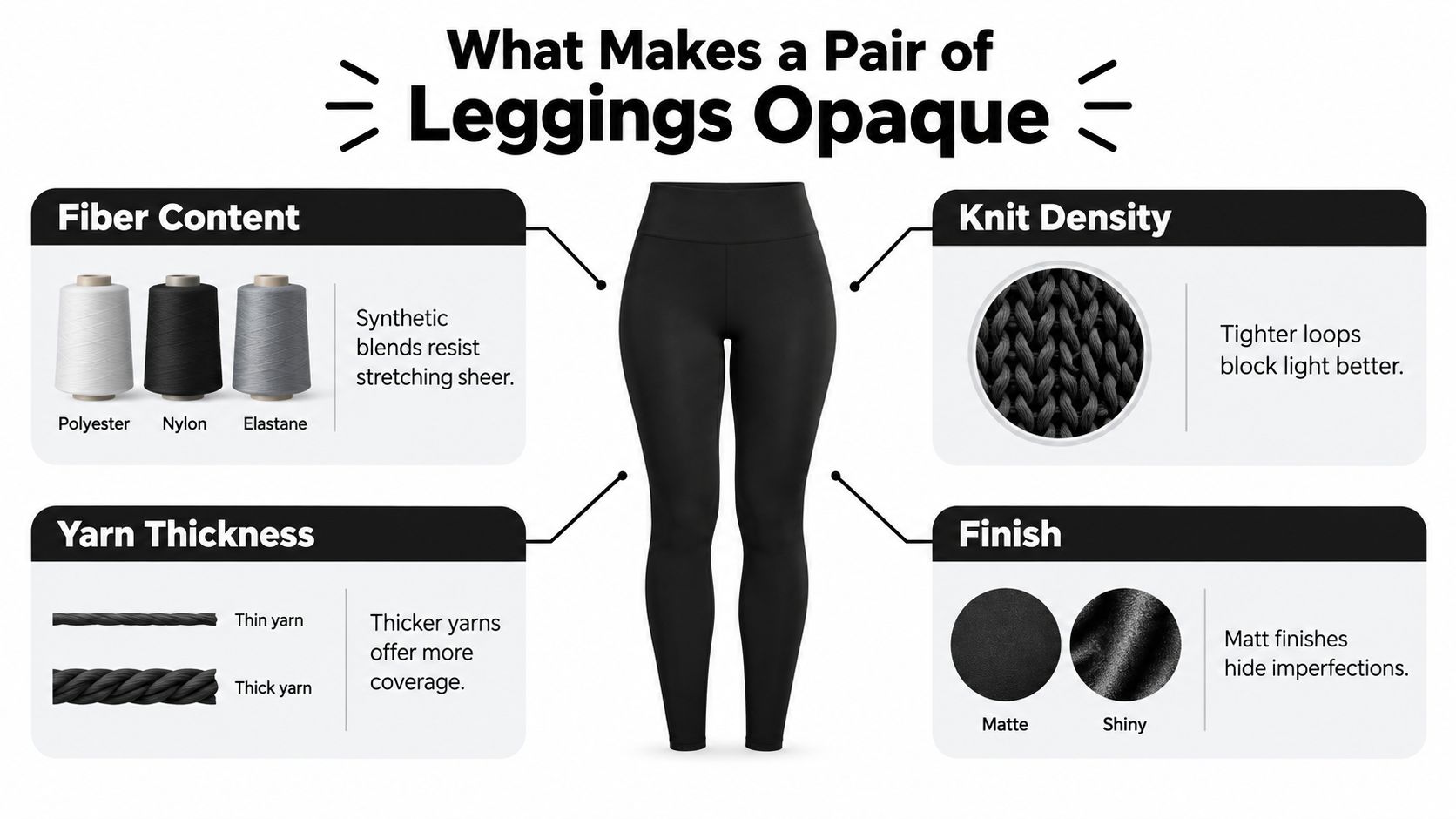
The fabric blend matters because different fibres stretch, recover, and hold shape differently. In plain terms, leggings need some resilience. A fabric that stretches out and stays strained is much more likely to turn translucent where it's pulled hardest.
That's why synthetic blends are so common in active and fitted leggings. They usually cope with repeated movement better than pure natural fibres. If you're comparing comfort across softer casual basics, this guide to comfort loungewear fabrics is a helpful companion read because it shows how fabric choice changes feel as well as performance.
Think of knit density like the difference between a sturdy tea towel and a loose cheesecloth. Both are fabric. Only one blocks what's behind it.
A tight knit keeps its surface more closed even when stretched. A loose knit opens up into tiny gaps. Those gaps are what let skin tone and underwear show through, especially across the seat, upper thigh, and crotch area.
Fine yarns can make leggings feel light and sleek, but they can also create less visual cover if the knit isn't dense enough. Thicker yarns usually give the fabric more body and help it keep a more solid appearance under strain.
This doesn't mean every thick-feeling pair is automatically safe. A bulky but loosely built knit can still turn sheer when worn. It just means yarn thickness is one piece of the picture, not the whole answer.
Practical rule: If the fabric looks smooth and solid at rest but turns into visible little channels or loops when pulled, the problem is construction, not just weight.
Surface finish makes a difference too. A very shiny finish can draw attention to areas where the fabric is under tension. A more matte finish often disguises minor variation better.
Colour also changes the result. Deep shades tend to hide small weak points better, while pale pinks, stone, light grey and other softer tones reveal them quickly. That's why two leggings in the same style can perform differently depending on colourway.
When shoppers search for women's leggings not see through, they often focus on one clue, usually “thick fabric”. In reality, opacity depends on how all four of these factors work together.
If you want one technical detail that's useful, it's GSM, or grams per square metre. It tells you how much fabric mass sits in a given area. It doesn't tell you everything, but it gives you a far better starting point than product photos alone.
Industry guidance points to 220 GSM as a minimum floor for squat-proof coverage, with 230 to 250 GSM described as the practical sweet spot and 250 to 260 GSM as a range for high-confidence opacity across body types. The same guidance recommends denser constructions such as interlock or double-knit because they open less under stretch (fabric weight and knit guidance).
A lower GSM legging can feel soft and light, which some people enjoy for lounging. But once you ask that fabric to stretch over hips, thighs and knees, you may see the knit separate.
A midweight to heavier pair often gives a more secure feel for everyday wear. That's usually where leggings start to look reliable for walking, commuting, light workouts, and repeated washing.
Knit structure changes the result just as much as weight.
A useful way to think about this is that GSM tells you how much fabric you have, while knit structure tells you how that fabric is arranged.
| Activity | GSM Range | Recommended Knit | Opacity Expectation |
|---|---|---|---|
| Lounging | Below the stronger opacity ranges often used for performance pairs | Denser knit if you want more coverage | Can vary a lot, test carefully |
| Yoga | 220 GSM as a sensible floor | Interlock or double-knit preferred | Should hold up for general movement if fit is right |
| Running | 230 to 250 GSM | Dense interlock or similarly stable knit | More reliable for repeated stretch |
| Gym and deep squat training | 250 to 260 GSM for higher-confidence coverage | Interlock, double-knit, or similarly dense build | Best chance of staying opaque across body types |
A heavy fabric with a loose structure can still fail. That catches people out because the leggings feel substantial in your hand, so you assume they'll be safe.
They might not be. If the knit opens when stretched, opacity drops. That's why the most useful shopping habit is pairing fabric weight with a real movement check at home instead of trusting the label alone.
You don't need specialist equipment to check leggings properly. You just need light, a mirror, and a repeatable method. I'd use two tests because each one catches a different weakness.
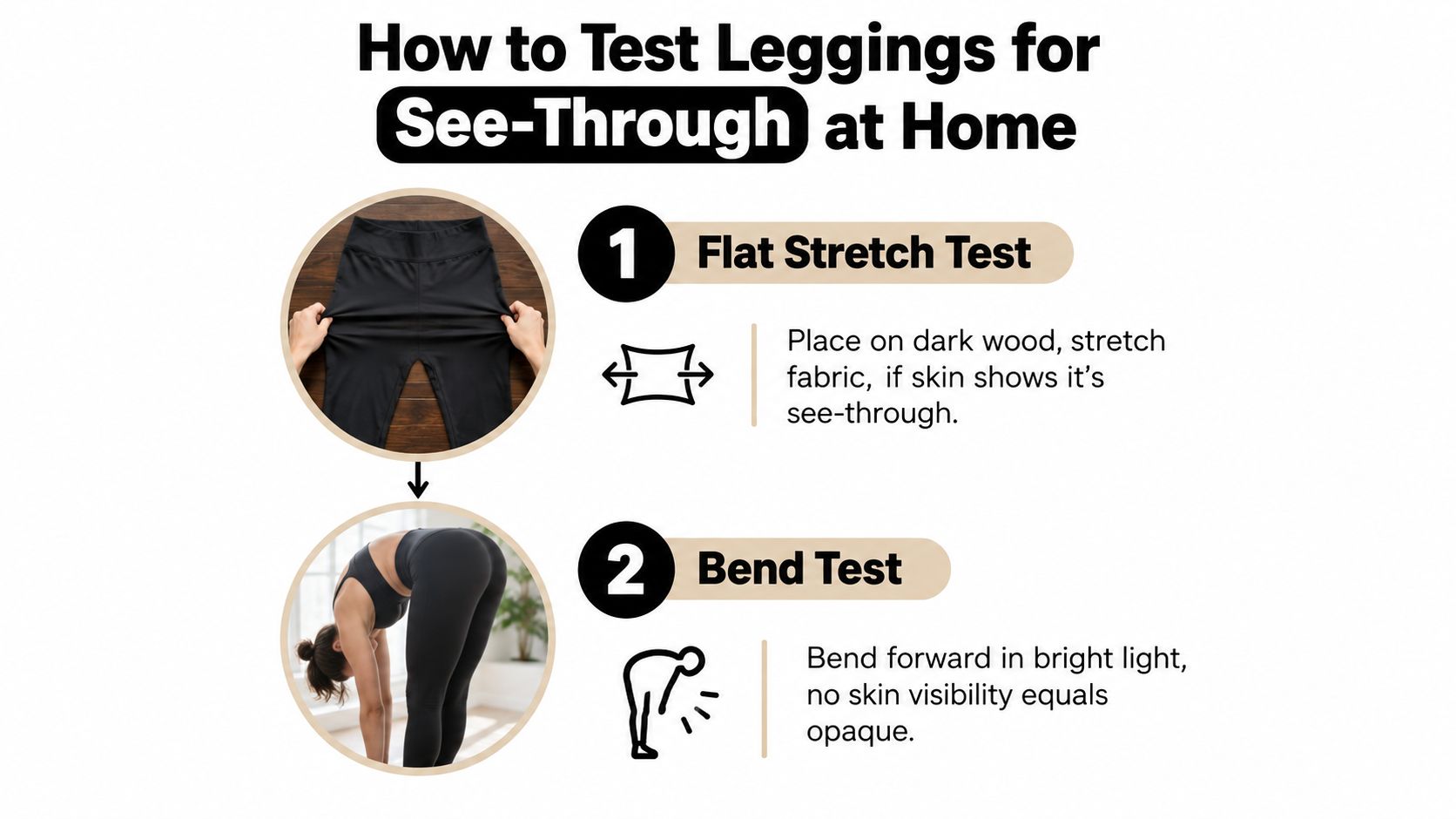
Lay the leggings on a dark table or another dark surface. Focus on the knee, thigh, and seat panels because those areas often thin first.
Then:
A useful benchmark from industry analysis is a stretch at roughly one-and-a-half times the fabric's resting width as a proxy for squat stretch. If the knit still looks solid rather than like an open grid of loops, it's more likely to stay opaque under strain (fabric stretch proxy for opacity).
The second test matters more because it reflects real wear. Put the leggings on in front of a mirror, use bright light, and move.
A movement-based test is straightforward. Wear the leggings, then perform a deep squat or bend. If underwear or skin becomes visible at the seat, back of the thighs, or crotch area, the garment isn't squat-proof (deep squat test guidance).
Light colours need a harder check. Guidance recommends using contrasting underwear and examining the leggings in daylight or bright artificial light because contrast reveals sheerness much faster than matching underwear does (light-colour legging testing advice).
If a pair only passes in dim light or with carefully chosen underwear, it doesn't really pass.
The flat test helps you spot:
The on-body test reveals:
If the result is borderline, compare two pairs side by side. Take a quick mirror photo in the same light and same pose. That gives you a far fairer comparison than relying on memory.
Two pairs with similar fabric can behave very differently once they're on the body. That's because opacity doesn't sit in the fabric alone. It sits in the relationship between fabric, cut, and tension.
If the waistband sits too low, the front and seat often take more pull than they should. If the rise is too short, the crotch area works harder and can start to look stressed even before you move properly.
A diamond gusset usually helps because it spreads strain more evenly through the crotch area. Side panels can help too, especially if they shift tension away from one central back seam.
Signs the fit is too small include:
Going too large can cause different problems. Extra fabric may sag, slide, and bunch, which then changes where the knit pulls when you bend.
Pale shades need more caution. Light grey, blush, stone and pastel tones tend to show the contrast between skin, underwear and fabric much more readily than navy, charcoal or black.
That's why many women find one shade wearable and another shade in the same style much less forgiving. The construction may be identical. The visibility is not.
If you want outfit ideas that balance leggings with longer tops, layers and proportions, Peppervale's guide on what to wear with leggings is a useful read.
A dark legging can hide a minor weakness. A pale legging exposes it immediately.
Curvier hips and thighs naturally place more demand on the knit, so support features matter more. That doesn't mean you need harsh compression. It means you need a cut that distributes stretch better.
Look for:
The best size choice is usually the one that matches your hip measurement most closely, because that's often where the greatest stretch pressure sits.
A good pair can lose opacity long before it looks old if you wash and dry it harshly. Heat, friction and product build-up all affect how the knit recovers after stretching.
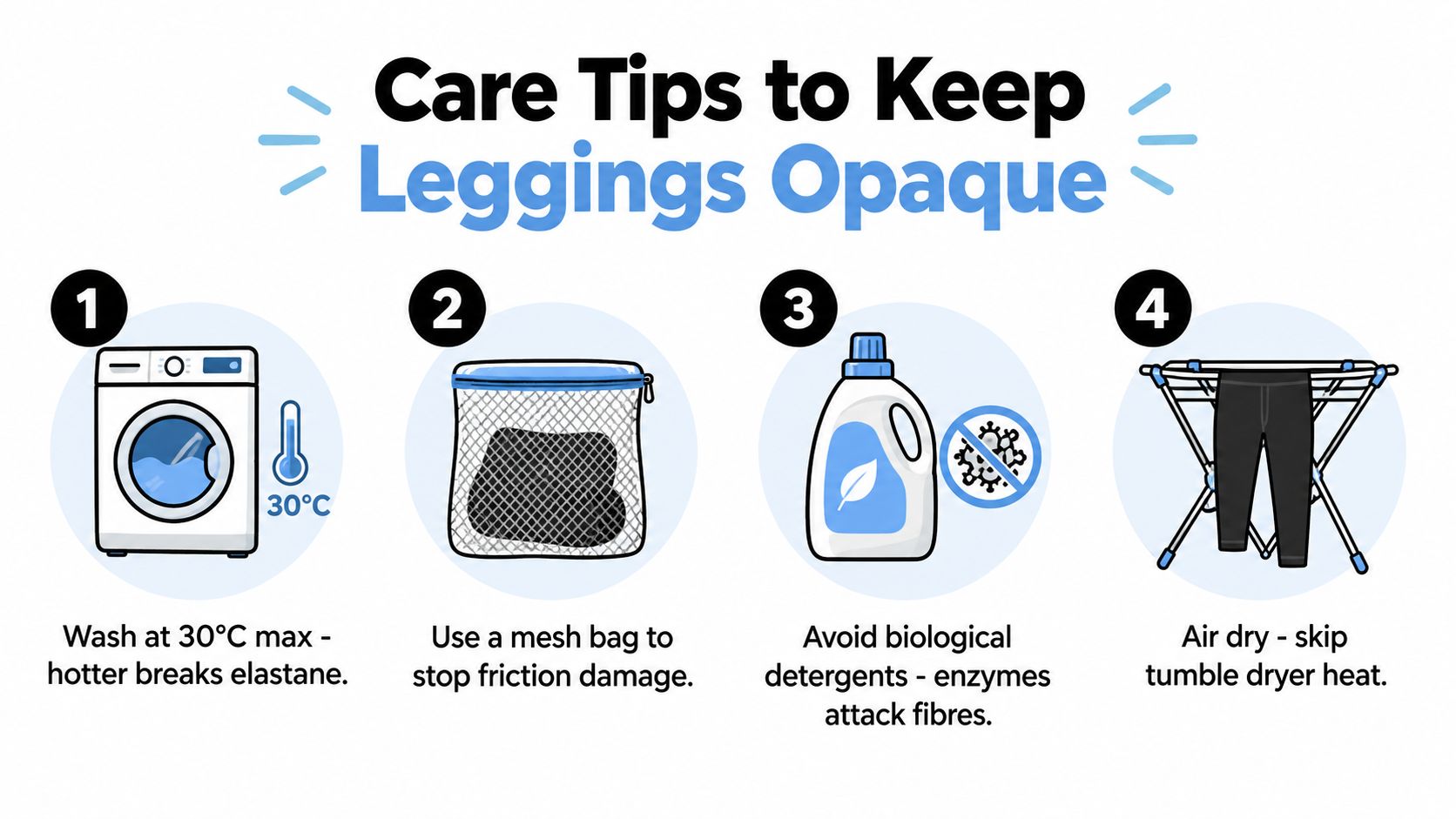
A gentle wash helps the fabric keep its spring. For many leggings, 30°C is a sensible upper limit if you want to protect elastane and reduce stress on the knit.
A mesh laundry bag also helps because it cuts down friction against zips, hooks and rougher garments in the same wash.
Try this routine:
Fabric softener is a common mistake. It can coat fibres and reduce the crisp recovery that helps leggings spring back after stretching.
Some shoppers also prefer to ditch scented detergents for sensitive skin for a simpler laundry routine. That article is useful if you're reassessing what you wash close-fitting basics in, especially if strong fragrance is something you'd rather avoid.
Radiators and tumble dryers are hard on fitted stretch fabrics. High heat weakens recovery, and once that snap-back goes, leggings often start looking thinner at the knees, seat and inner thighs.
Dry them flat or on an airer away from direct heat. It takes longer, but the fabric usually keeps its shape better.
If you wear leggings for movement as well as casual use, Peppervale's overview of women's activewear offers broader buying context around practical sports basics.
Don't wait until a public wardrobe failure tells you the fabric has gone. Give often-worn pairs a quick inspection.
Check for:
Rotate your pairs if you wear leggings frequently. One overworked favourite usually wears transparent much sooner than a small rotation of regularly used pairs.
When you're browsing online, the aim is to filter quickly and test properly once the pair arrives. A simple checklist keeps you from getting distracted by flattering photos and vague wording.
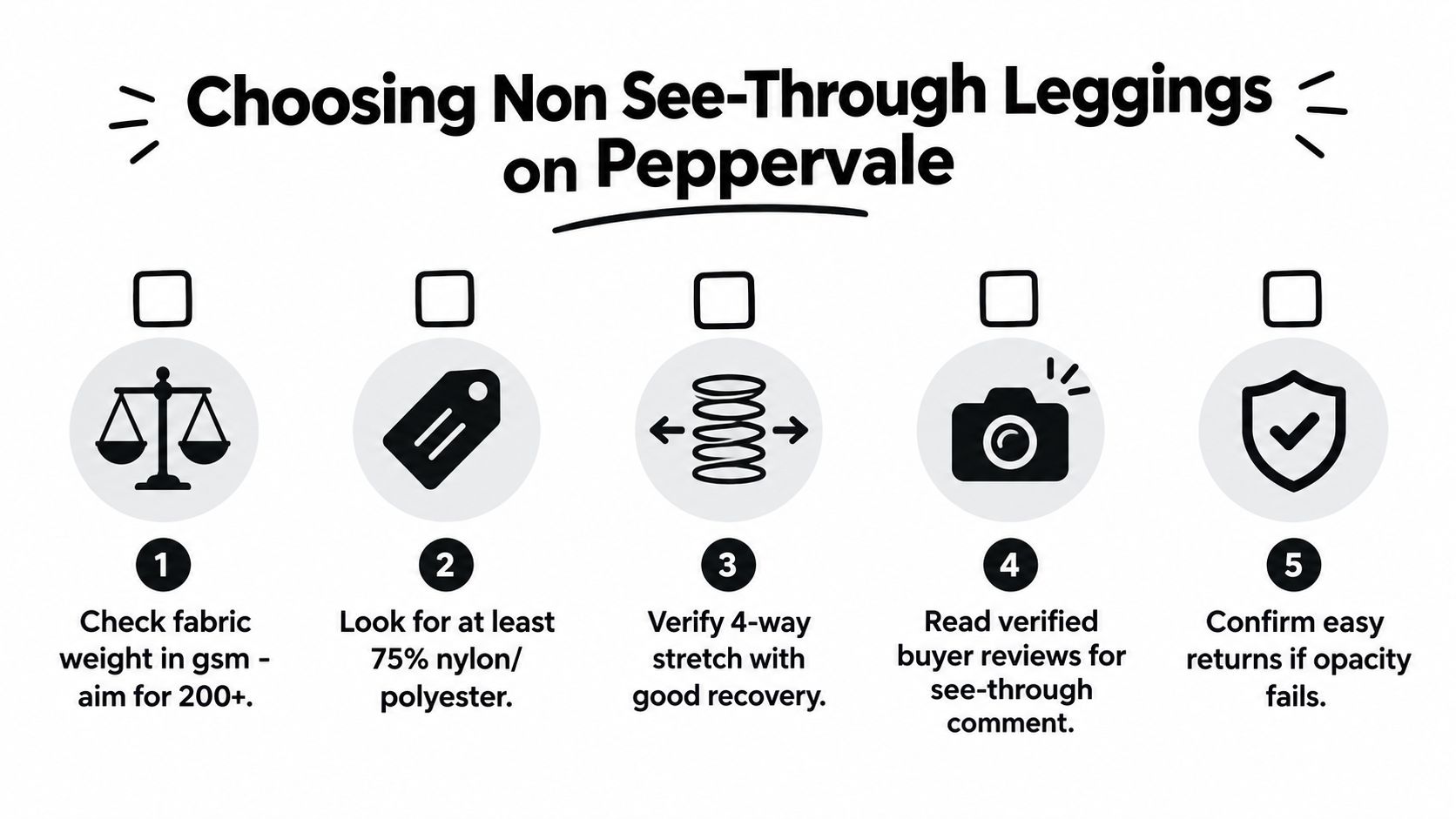
Look for these details before adding anything to your basket:
Online photos can't tell you enough. Studio lighting, editing and pose choice can make weak leggings look far better than they perform.
The product page matters more than the image gallery. Composition, construction notes and cut details are usually much more useful clues. If you're comparing styles, a product such as Peppervale's organic cotton stretch leggings for women is the sort of listing where you'd want to inspect fabric information, fit notes and colour options carefully on the live page rather than assuming all stretch leggings behave the same way.
Opaque leggings should feel supportive, not punishing. If a pair feels as though it's already working at full stretch while you're standing still, it's unlikely to improve once you move.
The strongest buying habit is also the least glamorous. Check the fabric details, choose colour sensibly, and test the pair in bright light before the first proper wear. That's the simplest route to finding women's leggings not see through without wasting money on hype.
Peppervale offers a broad UK range across clothing, footwear, accessories, home and everyday essentials, which makes it a practical place to compare basics as part of a wider shop. If you're looking for leggings that work for real life rather than just product photos, browse Peppervale and use the stretch, light and fit checks in this guide before you settle on a pair.


