Share:

- Women
- Men
- Kids & Baby
- Workwear
- Footwear
- Accessories
- Home & Living
- Health & Beauty
- Pet Supplies

The most popular advice about UK women's fashion is also some of the least useful: buy more, refresh your wardrobe constantly, and treat every runway signal as a shopping list. That approach ignores the reality of British wardrobes, where budgets are tight, sizing varies between retailers, online returns eat into both time and money, and most clothes need to work for commuting, childcare, hybrid offices, weekends and unpredictable weather.
Smart style in 2026 is less about constant novelty and more about fit, repeat wear and deliberate buying. A chocolate-brown knit, wide-leg trouser or soft blazer can look current without forcing you to replace everything you own. The skill is translating a trend into a garment you'll wear repeatedly, then checking that it fits your actual body rather than an arbitrary label.
UK women aren't endlessly refreshing their wardrobes. In March 2025, only 51% of consumers said they spent on clothing, shoes and accessories every month, while average monthly spending sat between £25 and £49, according to Attest consumer spending data reported by FashionUnited UK. That's a selective shopping pattern, not a permanent appetite for newness.
The practical consequence is straightforward. Each purchase has to earn its place. A top that works with jeans, trousers and a skirt is more useful than a dramatic piece that only suits one outfit. A pair of trousers that fits comfortably through a working day is worth more than a cheaper pair that spends most of its life waiting for an alteration or return.
Tight clothing budgets change the meaning of value. The lowest ticket price doesn't necessarily produce the lowest cost. Delivery charges, return postage, tailoring, poor fabric recovery and unworn purchases can turn a supposedly cheap item into an expensive mistake.
Shoppers are also more alert to wardrobe fatigue. Repeatedly buying similar black tops because the previous ones fit badly isn't variety. It's a fit problem disguised as shopping. Before buying, ask whether the garment solves a genuine gap, works with at least several existing pieces, and feels comfortable enough for the occasions you attend.
Practical rule: If you can't name the outfit, setting and weather conditions in which you'll wear a new item, leave it in your basket.
The strongest approach to UK women's fashion is therefore strategic rather than restrictive. Keep a record of the trousers, bras, tops and shoes you reach for most. Note their measurements, fabric behaviour and proportions. Those details are more useful than a vague commitment to “buy better”, because they give you a repeatable standard for future purchases.
There's no universal correct wardrobe budget. A smaller monthly spend can still produce a polished wardrobe if purchases are spaced out and chosen around existing clothes. Someone who shops less frequently should prioritise dependable foundations first, then add trend-led colour, texture or accessories when the core combinations are working.
The shift is psychological as well as financial. Shopping becomes a decision about utility, comfort and confidence, not a response to every new product drop. That mindset makes fashion feel less frantic, while raising the standard each garment must meet.
| Year | Average items purchased | Average annual spend (£) | Return rate (%) |
|---|---|---|---|
| Not provided in verified data | Not provided | Not provided | Not provided |
No verified source supplied for the table's requested year-by-year figures, so those fields shouldn't be invented.
UK womenswear is still a large retail market, but shoppers are reaching it through different channels and demanding more from each purchase. Market research for 2023 placed consumer spending at £32.2 billion, with spending up 4.2% that year. The practical lesson is clear: a busy market does not justify careless buying. It gives shoppers more places to compare fit, fabric, price and service.
Online shopping now sits at the centre of womenswear retail. Online penetration reached 43.8%, after rising by 1.1 percentage points, according to Research and Markets' UK womenswear market report. Product photography, garment measurements, customer reviews, delivery terms and returns policies now influence a purchase before a shopper ever sees the garment in person.
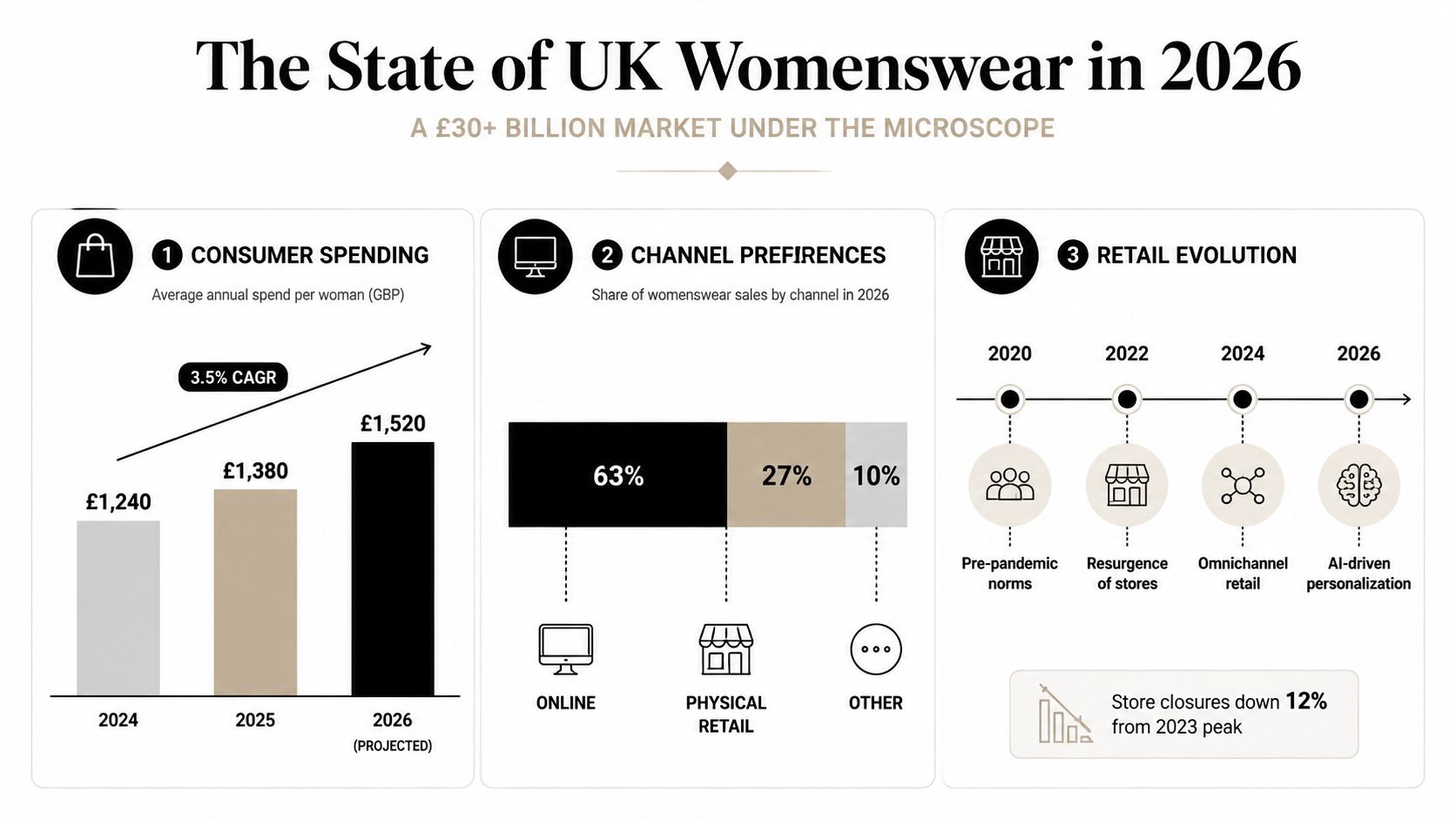
Physical specialist retailers have lost ground. Between 2018 and 2023, their share of the UK womenswear market fell by 10.3 percentage points, reflecting the move towards digital channels. Shoppers can compare brands, colours, measurements and prices without crossing town between high-street stores.
Convenience has raised the standard for retailers. A brand needs a clear reason to earn the sale, such as reliable fit, useful styling, fair pricing, distinctive design or a straightforward returns process. Mid-market businesses face the hardest test when they offer neither premium construction nor value pricing.
That pressure affects the customer's budget. An attractive product page can hide pulling across the bust, a high armhole, thin fabric or a waistband that rolls when seated. A cheap item becomes expensive after return postage, alteration costs and the time spent finding a replacement. Read the product page as technical information, not only as inspiration.
A large market does not require a large wardrobe. It gives shoppers more routes to the same purchase, from department stores and high-street chains to online-only retailers and marketplaces. Compare the garment, not the brand reputation.
Start with clothes you already wear. Neutral trousers, denim and knitwear can support a current colour or silhouette without creating an entirely new outfit system. Choose retailers whose measurements, fabric descriptions and returns terms reduce guesswork. Then adapt runway ideas through one affordable piece, rather than replacing clothes every time the trend cycle changes.
A size label is a brand's estimate, not a dependable measurement. Cuts vary between retailers and even between garments carrying the same label. Tellar's garment measurement research, based on more than 1,000 garments across 50 brands, found that the average shopper orders 24 clothing items online each year and returns 8 for poor fit. It also estimated around £36 spent annually on return shipping, with sizing inconsistency costing UK shoppers £56.70 per person per year and approximately £1.98 billion nationally.
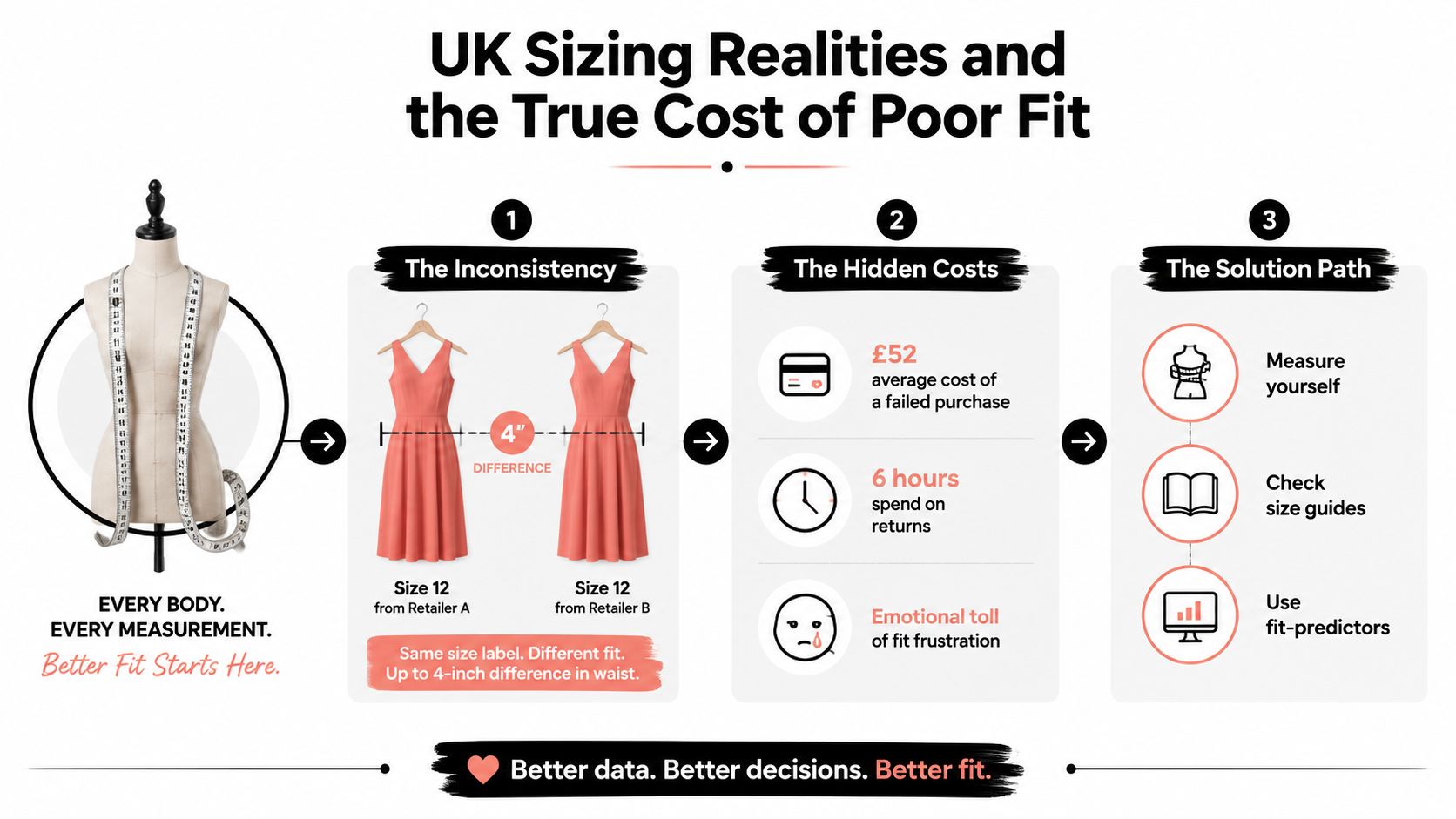
Returns create costs beyond the individual order. A Whistl UK ecommerce returns fact sheet reports that 71% of UK online shoppers return items at least sometimes, while clothing is the most returned non-food category at 27%. Sizing is identified as the main reason for returning apparel, and online returns cost UK retailers £5.2 billion a year. For shoppers on a tight budget, the price includes postage, time, replacement purchases and the temptation to keep an uncomfortable garment to avoid more hassle.
Use a garment you already own and wear confidently as your reference point. Lay it flat without stretching, then measure the relevant areas, including chest, waist, hip, inside leg, rise, shoulder width and garment length. Save those figures in your phone with the fabric composition and notes on whether the item loosened or tightened after washing.
Compare garment measurements with the retailer's measurements. Do not match your body measurement directly to a garment measurement unless the brand explains its allowance for ease. A woven shirt, ribbed jersey top and stretch leggings each need different room for comfortable movement.
Your bust, waist and hip measurements may not explain every fit problem. Check sleeve length, rise, thigh width, calf opening, bra support and shoulder placement when the product page lists them. Missing information raises the purchase risk, especially for structured pieces.
UK women's sizing also exposes a range-planning problem. Aggregate data suggests the average British woman wears between UK size 16 and 18, 62% wear UK 16 or above, and 47.4% are classified as plus-size at UK 18 or above, according to MYS Tyler's UK women's sizing insights. The same dataset identifies 38DD as the most common bra cup size, with 58.5% wearing DD or larger.
These figures are a reason to judge proportions, not your body. Retailers should grade fit carefully across the full range, rather than treating larger sizes as an afterthought. A label cannot tell you whether the shoulder, bust, rise or sleeve will work.
Use this UK women's clothing size guide alongside the brand's own chart. Size up when a structured garment pulls across the fullest point, the fabric has little recovery or movement feels restricted. Alterations are sensible when the main fit is already right and the construction permits adjustment, such as a trouser waistband, sleeve hem or simple side seam. They will not correct a wrong shoulder line, rise or bust shape. Choose the better-cut garment first, then spend on alterations only when they extend a piece you will wear.
Runway direction is useful as a colour and proportion signal. It isn't a command to purchase a new wardrobe. For ordinary UK days, the question is whether a trend can survive rain, public transport, sitting at a desk, walking to school and several rounds in the washing machine.
Current styling themes favour comfort-led tailoring, soft textures, muted earth tones and utility. Those ideas translate well because they can be added through one garment or an accessory rather than an entirely new outfit.
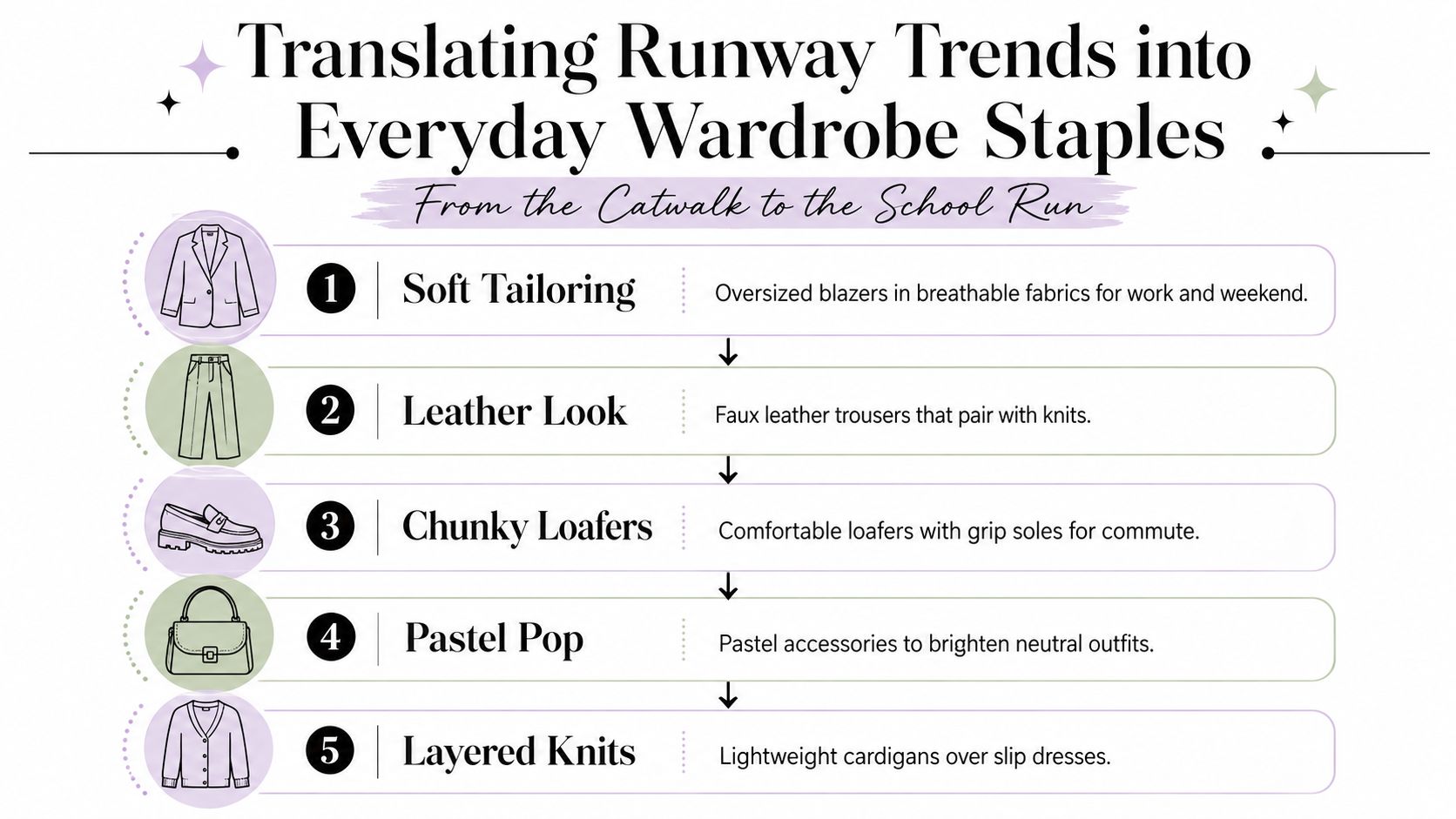
Soft tailoring means structure without stiffness. Choose a relaxed blazer in a breathable fabric and wear it over a T-shirt, fine knit or dress. M&S and Next often provide accessible versions of the shape, while Arket is useful for comparing a more minimalist cut. Check the shoulder seam and sleeve length first. An oversized blazer should look intentional, not too large.
Soft textures work best through knitwear. A brushed cardigan, fine jumper or tactile scarf can make a familiar jeans-and-trainers combination feel considered. Keep the rest of the outfit simple so the texture remains the feature rather than competing with several trend signals.
Muted earth tones are easy to absorb because they sit alongside navy, denim, cream, black and grey. Chocolate brown trousers, a mossy cardigan or a warm beige overshirt can replace a neutral you already wear. That's a more economical move than buying a complete colour story.
Elevated utility needs restraint. Look for useful pockets, a strong collar, a practical jacket or a trouser with a clean cargo influence. Avoid adding several bulky details at once, particularly if you need a comfortable layer under a coat.
Styling formula: Keep the base familiar, add one current silhouette, then finish with a practical shoe or bag.
A £40 pair of wide-leg trousers can outperform a £120 jacket if the trousers work across commuting, casual days and evening plans. The price alone doesn't establish value. Wear frequency, laundering demands, alterations and compatibility with your existing wardrobe do.
Try these formulas:
Use this video for visual outfit inspiration, but test every look against your own proportions and routine:
The point of trends in UK women's fashion is not to look like a runway image. It's to borrow a proportion, texture or colour that makes your existing wardrobe feel useful again.
A pure capsule wardrobe reduces daily decisions, but it is not automatically the cheaper option. Buying several well-made basics together requires more money upfront than a run of low-cost trend purchases. Trend cycling looks affordable at the till, then costs more through poor fit, returns, duplicate garments and pieces that work with nothing else.
The hidden cost is inconsistency. If a supposedly reliable basic pinches, needs an alteration or only works with one bra and one pair of shoes, its price per wear rises quickly. A smaller wardrobe saves money only when the clothes fit properly and suit the wearer's actual routine.
For a shopper choosing between an annual budget of £600 or £1,200, the sensible choice depends on lifestyle, existing clothes and tolerance for repetition. These figures are planning examples, not market averages.
| Factor | Capsule approach | Trend cycling | Hybrid 70/30 |
|---|---|---|---|
| Annual spend | Concentrated on fit-verified foundations | Spread across frequent novelty purchases | Most spend supports reliable basics |
| Outfit variety | Created through layering and accessories | High visual novelty, weaker coordination | Stable base with seasonal change |
| Decision fatigue | Lower once the wardrobe works | Higher because each purchase creates new choices | Manageable and deliberate |
| Sustainability impact | Fewer, more repeatable garments | Greater risk of unworn or quickly discarded items | Limits novelty while preserving interest |
| Lifestyle adaptability | Strong if the capsule reflects real routines | Strong for immediate trend changes, weaker for practical gaps | Most flexible for work, weekends and events |
A capsule suits someone with predictable dressing needs who values repeat combinations. It fails when the chosen “essentials” do not fit or reflect daily life. Coordinated trousers that pinch at the waist are not useful, and tops that do not accommodate your preferred bra will stay unworn.
Trend cycling works for shoppers who enjoy experimentation and can control impulse buying. It becomes expensive when a sale replaces a plan. A low price does not justify a garment that needs a new bra, special shoes and an alteration before it becomes wearable.
A 70/30 split is a practical starting framework. Put most of the budget towards fit-checked basics, outer layers, shoes and underwear. Reserve the remainder for one colour, texture, silhouette or accessory that refreshes the wardrobe. Adjust the ratio when work or social commitments change.
Check the core against a normal week. Can you build enough outfits without repeating the same combination too often? Do your trousers work with several tops? Can your shoes handle the distance you walk? Do your layers cope with UK weather?
Build gradually from a focused list of women's basics. Keep notes on what fits, what needs altering and what you wear regularly. A full rail is not a functional wardrobe, and chasing every new trend will not fix poor foundations.
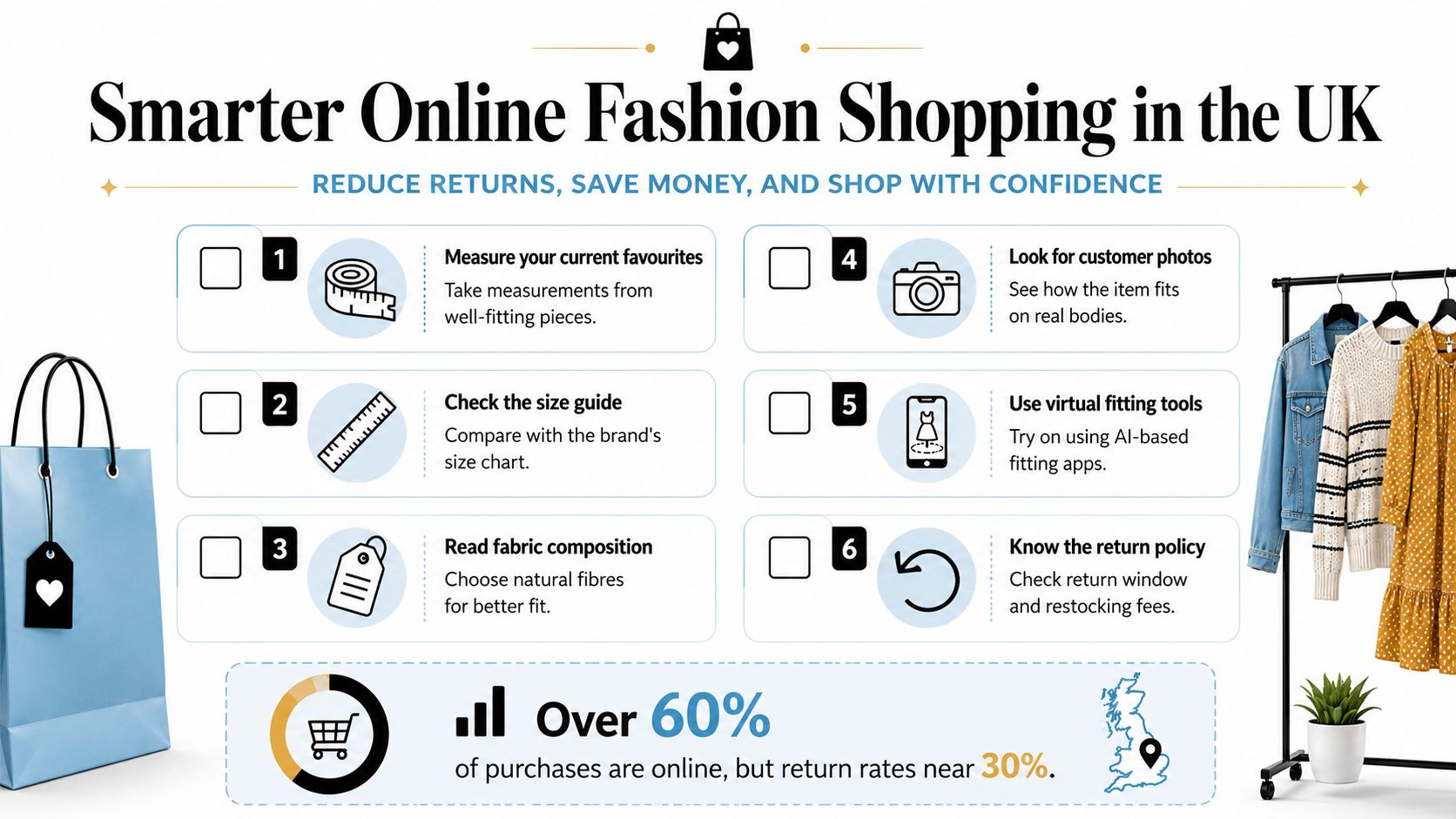
Online convenience becomes expensive when shoppers trust inconsistent size labels. Returns take time, create extra delivery and packaging costs, and can leave money tied up while a wardrobe gap remains open. Clothing is among the items most often sent back, so move as much of the fitting process as possible before payment.
Flash-sale language rewards speed rather than accuracy. Remove saved payment details if you buy impulsively, write down the specific wardrobe gap, and compare the proposed purchase with clothes you already own.
A delivery threshold helps only when the additional item was already planned. Otherwise, it turns a postage charge into unnecessary spending. Bundles create the same trap. A multi-buy offer lowers the unit price while increasing the number of garments you must justify and store.
Use this guide to an online clothing store in the UK as a prompt to check product measurements, fabric details, delivery terms and return conditions before checkout. Treat every product page as a fitting document, not a mood board. That discipline protects a tight clothing budget and makes runway-inspired choices easier to wear in everyday outfits.
Start with a fit audit, not a shopping list. Take every garment you wear regularly and separate it into three groups: fits well, needs an alteration, and never gets chosen. The third group usually reveals the problem, whether that's an uncomfortable neckline, a trouser rise that doesn't suit you, sleeves that ride up or colours that don't combine easily.
A woman working partly from home and partly in an office might discover that she doesn't need another formal outfit. She needs trousers that feel comfortable at a desk, a washable layer for video calls, a smart shoe for commuting and tops that work under both a cardigan and a blazer. That list is more useful than copying a capsule wardrobe checklist designed for someone else.
Fill the most repeated gap first. If trousers are the weak point, measure a pair that fits, compare rise and inside leg across retailers, and order only when the return conditions are clear. If your tops are all too casual for work, add one structured layer before buying more casual jersey.
Then introduce one trend. A muted-earth knit, soft blazer or utility-inspired overshirt can update several existing outfits. Photograph combinations before buying, because a garment that looks versatile in isolation may duplicate something already hanging in the wardrobe.
Keep a simple record of brands and measurements that work. Note whether a fabric stretched, shrank, creased heavily or held its shape. That information gradually becomes more valuable than a retailer's size label and reduces the mental effort behind every future order.
Don't bulk-buy during sales. Buy the piece you can place into an outfit immediately, check it properly at home, and return it within the stated conditions if the fit fails. A versatile wardrobe is built across seasons through repeated, informed decisions. It doesn't arrive in one dramatic shopping spree.
For practical everyday clothing, Peppervale offers UK online shopping across casual apparel and accessories, with product availability, GBP pricing, delivery information and returns details available through its storefront. Visit the site when you've identified a specific wardrobe gap, then compare the garment details with your own measurements before ordering.


