Share:

- Women
- Men
- Kids & Baby
- Workwear
- Footwear
- Accessories
- Home & Living
- Health & Beauty
- Pet Supplies

You're standing in a bedding aisle or scrolling a boutique site, looking at two duvet cover sets that both call themselves luxury, and the price gap makes no sense. One looks polished, one sounds more exclusive, and both promise a better night's sleep, so the key question becomes simple: what are you paying for?
A good luxury bed linen UK purchase isn't about trusting the loudest label. It's about learning to separate marketing signals like headline thread counts and hotel-style wording from engineering signals like weave, yarn quality, finishing, and origin. If you can read those signals properly, you can tell which set is built to last, which one only looks premium on the shelf, and which details still matter after a wash at 40°C.
That matters in a market where bed linen is already the largest product segment in the UK luxury bedding category, which was estimated at USD 88.4 million in 2024 and forecast to reach USD 138.5 million by 2035 with a projected CAGR of about 4.17% from 2025 to 2035 (Spherical Insights). It also matters because UK shoppers are being pulled toward comfort, wellbeing, and performance, not just status, in a broader home textile market that is projected to rise from USD 7.62 billion in 2025 to USD 8.46 billion by 2031 and where bed linen accounts for 45.92% of the market in 2025 (Mordor Intelligence).
For a first-time buyer, the toolkit is straightforward. Look at the fibre, then the weave, then the finishing and provenance. Those three checks tell you far more than a shiny box ever will.
The common buying mistake is to treat all “luxury” bedding as if it's the same thing with different packaging. That's how a set at £120 and a set at £320 end up looking interchangeable, even when one is built with more care and the other is mostly selling a story.
The packaging usually makes the confusion worse. You'll see phrases like hotel style, 1000 thread count, extra soft, or premium finish, then a care label that says something very ordinary once you look closely. The buyer is left guessing whether the higher price reflects better cloth, better stitching, or just better copy.
Practical rule: if a claim sounds grand but doesn't tell you the fibre, weave, or yarn construction, treat it as decoration, not evidence.
A useful way to think about bedding is to ask what survives real use. Does it still feel good after washing? Does the fabric hold its shape? Does it breathe well enough for a warm bedroom or a summer night? Those questions matter more than a slogan, because the things that make sheets comfortable usually show up in the structure of the cloth, not the box they arrive in.
If you want a starting point for comparing proper sheet types rather than just labels, this guide on the best bed sheets in the UK is a useful companion to the basics here.
Fibre tells you what the cloth is made from, and that shapes softness, breathability, and care.
Weave tells you how the yarns are arranged, and that shapes the feel in your hand.
Finishing and provenance tell you how the cloth was made, processed, and described, which is often where the honest brands separate themselves from the glossy ones.
That's the frame to use every time you shop. Not, “Which one looks richest?” but, “Which one is made better?”
You are comparing two white duvet sets in a UK shop. Both claim a premium finish, yet one product page explains its fibre and weave while the other relies on “hotel style” and a polished photograph. The useful question is not which package looks more luxurious. It is which claims describe cloth you can verify.
Luxury bed linen is best understood through measurable traits: long-staple fibre, consistent weave, careful finishing, and clear provenance. These engineering signals affect how fabric feels, breathes, washes, and holds its shape. Marketing signals, such as a dramatic thread-count figure or hotel-style wording, may describe appearance without proving how well the linen is made.
UK shoppers encounter heritage brands, hotel supply lines, and direct-to-consumer labels. That range can make comparison easier, because a serious retailer should provide specific information about fibre, weave, certification, or country of manufacture. A useful overview of UK home textiles and buying considerations can help put those details in context.
Bedding's history also explains why some materials still carry prestige. Academic research on the linen industry notes that linen was once widely used for household goods such as bed linen, while historical work shows cotton overtook linen as England's most popular textile in the nineteenth century (Oxford Academic). Linen therefore retains a premium association, even though cotton became the everyday bed textile.
Inflated thread counts deserve caution. A larger number does not by itself prove a better sheet. “Egyptian cotton” is more useful when the product page gives specific, credible information about the claim. “Hotel style” usually refers to the bed's appearance or drape, rather than the cloth's construction.
Phrases such as “ultra-soft” and “five-star feel” are similarly limited. They may describe the first touch, but they do not establish durability, breathability, or washing performance. Look for the material story on the product page, not in the packaging.
A luxury label earns trust when it points to something you can check, such as fibre type, weave, origin, and finish.
That is a practical standard for luxury bed linen UK shopping. The fabric should provide the evidence.
Thread count is the number of warp and weft threads per square inch. It's a density measure, not a universal quality score, which is why it can help a buyer, but only if it's read alongside the fibre and weave.
UK buying guidance places a well-made percale at around 180 to 200 thread count at the low end, with quality bedding often sitting around 200 to 400, and some premium cotton ranges going higher (Out of Eden). The same guidance also notes that returns diminish above roughly 500 to 600 unless the weave and fibre quality improve too. That's the key point many shoppers miss.
A high thread count can be reached in more than one way. One of the oldest tricks is using finer, multi-ply yarns so the count rises on paper without a matching rise in comfort or durability. The sheet feels denser, but that doesn't automatically make it better to sleep in.
This is why the smarter buyer treats thread count as a cross-check, not the headline. A single-ply long-staple cotton sheet in a sensible range can outperform a higher-count sheet made with weaker yarns. The better question is not, “Is it 1000?” but, “How was that number achieved?”
| Thread Count Range | Typical Fibre / Weave | What It Usually Feels Like | Reliable Quality Signal? |
|---|---|---|---|
| Under 200 | Basic cotton or lighter weaves | Light, sometimes thin | Usually not the luxury zone |
| 200 to 400 | Quality cotton percale, some bamboo-style comfort fabrics | Crisp, smooth, breathable | Often a strong sign when fibre and finish are clear |
| 400 to 600 | Sateen, denser cotton, some premium blends | Softer drape, more plushness | Can be good if yarn and weave are honest |
| Above 600 | High-density cotton, sometimes inflated multi-ply counts | Dense, heavy, sometimes warm | Only useful if construction details are disclosed |
For bamboo and heavier cotton, GSM can be a better clue than thread count, because it reflects fabric weight rather than just thread density. That makes it more useful when you're comparing cloth that's designed to feel smooth or substantial rather than crisp.
Thread count can help you filter options, but it can't tell you whether the cloth was made with care.
Stand in front of two expensive-looking bedding sets and the fibre label may explain more than the price tag. Cotton, linen, bamboo, and silk create different sensations because their fibres and finishes behave differently against the skin. Choosing well starts with matching those properties to the sleeper and the bedroom.
Long-staple cotton percale is the crisp choice. Its plain, matte surface feels cool and structured, making it suitable for anyone who prefers airy sheets in a heated bedroom or during warmer spells. Cotton sateen has a smoother, more fluid drape and a gentle sheen. That polished surface is the closer match for buyers who enjoy a softer, hotel-style feel.
European linen often feels textured when new, then becomes softer with use. It allows good airflow and handles changes in temperature well, so it suits sleepers who dislike fabric clinging to the body. Bamboo bedding, usually made from bamboo viscose, tends to feel smooth and fluid, with a soft hand and less heat retention than a heavier sateen construction. Mulberry silk is delicate and highly lustrous, with an indulgent feel and some warmth, but it requires more careful handling.
The material trend is also broadening. Interiors coverage points to greater interest in tactile luxury, linen, and eco-friendly materials, while guidance on luxury bedding describes a move away from thread-count hype towards responsible sourcing, certifications, and performance fabrics such as bamboo lyocell, TENCEL, linen, hemp, and silk (ZuluFish). For a UK buyer, fibre is therefore a performance choice as much as a prestige signal.
If you are comparing lower-impact options, organic bed linen in the UK provides useful context alongside weave, construction, and care information.
Watch the wording: bamboo is often presented as a natural miracle fibre, although bamboo bedding is usually processed into viscose or lyocell. That does not make it a poor choice. It means the description should be taken at face value, with the actual fibre process and fabric specification checked.
| Fibre | Feel & Finish | Breathability | Durability | Care | Typical UK Price Band |
|---|---|---|---|---|---|
| Long-staple cotton percale | Crisp, cool, matte | Strong | Strong when well made | Straightforward | Mid to premium |
| Cotton sateen | Silky, drapey, smoother sheen | Moderate | Good, but depends on yarn quality | Straightforward | Mid to premium |
| European linen | Textured, relaxed, softens over time | Very strong | Very strong | Slightly more forgiving with age, still needs care | Premium |
| Bamboo viscose | Smooth, fluid, soft hand feel | Good | Varies by quality and finishing | Usually easy, but check instructions | Mid to premium |
| Mulberry silk | Lustrous, very smooth, luxurious | Moderate | Delicate compared with cotton or linen | Highest care demands | Premium to very premium |
Choose percale for a cooler, crisper surface, sateen for softer drape, linen for texture and airflow, bamboo for smooth comfort, and silk for indulgence if careful washing and storage fit your routine. Once the fibre suits your needs, check whether the product page also explains the weave, yarn, and finishing. Those engineering details show whether the luxury language reflects the cloth itself.
A good product page reads like a materials label with better photography. The clues are there, but you have to know which ones are decorative and which ones are structural.
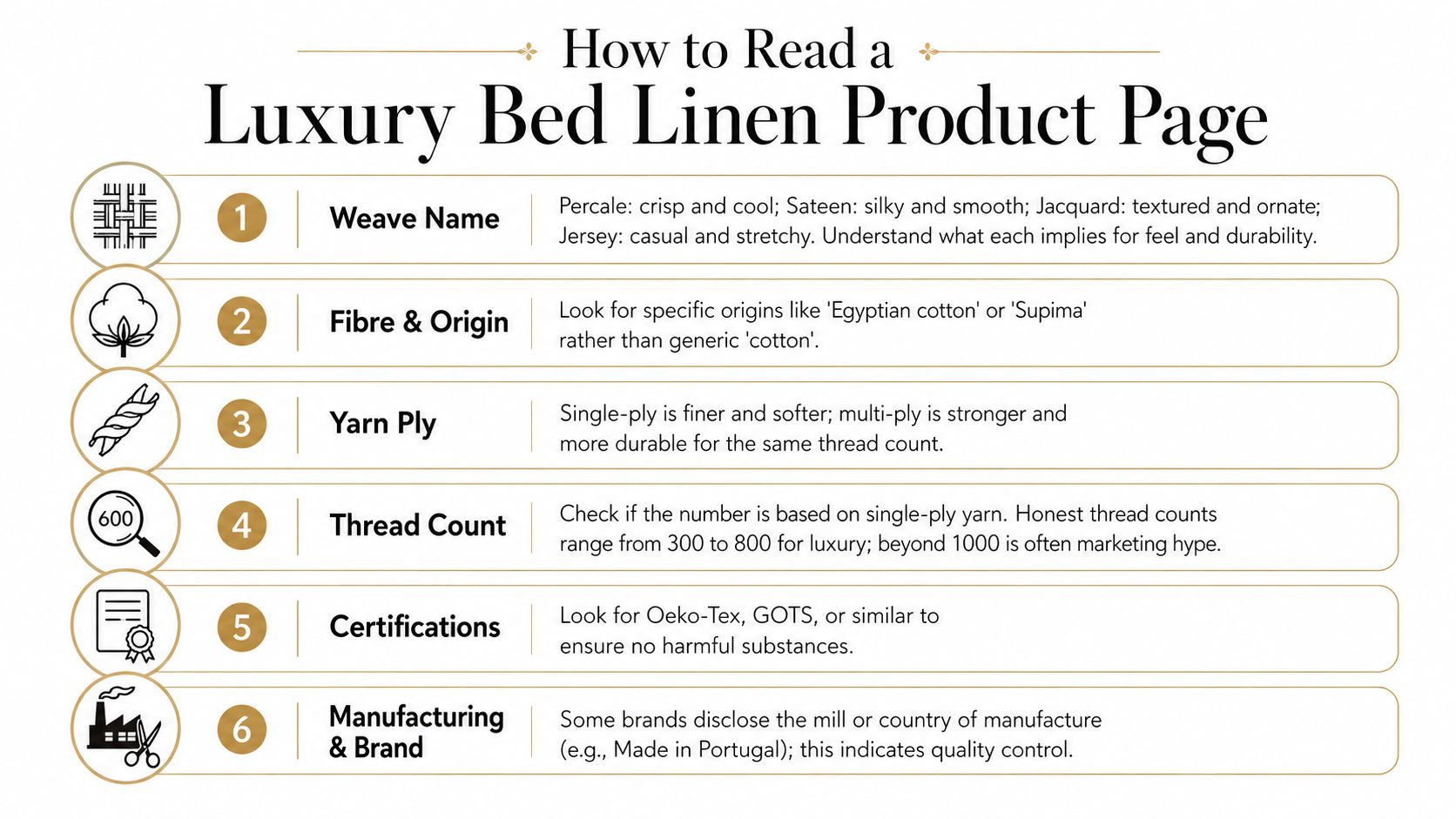
Percale means a plain weave that usually feels crisp and cool. Sateen means a weave that exposes more thread surface, which gives it a smoother, slightly lustrous finish. Jacquard points to a woven pattern, often more decorative, while jersey is knitted rather than woven, so it feels stretchy and casual.
Those weave names matter because they tell you what the sheet will do in use. A product called “luxury” but with no weave described is hiding the most useful clue on the page.
Single-ply yarn is usually a better luxury marker than a flashy multi-ply count because it says more about the actual structure of the cloth. If a brand gives you a thread count but no clue about ply, the number is doing too much work on its own.
Finishing terms also matter. Mercerisation can improve lustre and dye uptake in cotton. Sanforisation reduces shrinkage. Garment washing and stone washing change the hand feel, sometimes making cloth feel softer from day one. None of those terms is automatically good or bad, but each one tells you how the fabric was treated before it reached your bed.
Relevant labels include OEKO-TEX Standard 100, GOTS organic cotton, and the Better Cotton Initiative. They don't all mean the same thing, but they do tell you the retailer is trying to show a standard beyond a vague “premium” claim.
Origin can be helpful too. “Egyptian”, “Supima”, “Sea Island”, and “European flax” are names that can matter, but only when they're used precisely. If a product page just says “made from Egyptian cotton” without more detail, the claim deserves scrutiny.
Red flags
A strong product page makes the cloth intelligible. A weak one hopes you won't ask questions.
A buyer is shopping for a double duvet set and wants to stay around £180. Two listings look close enough at first glance, but their product pages tell very different stories.
Set A is a 1000 thread count Egyptian cotton sateen priced at £170. It carries an OEKO-TEX label, but the page doesn't say whether the yarn is single-ply or multi-ply, and it doesn't explain staple length. Set B is a 300 thread count long-staple cotton percale made in Portugal from European cotton, priced at £190, with named certifications and a single-ply specification.
The shopper's first instinct is to assume Set A wins because the number is higher and the price is lower. That would be a mistake. The 1000-count label tells you density, but not whether that density was achieved with better fibre or just more thread tricks. Set B says less on the headline and more about the actual build.
Set A may feel denser and more drapey. That can be appealing if the buyer wants a smoother, more enclosed feel. But without ply or staple information, there's a blind spot in the quality story.
Set B gives the buyer clearer construction details, and that usually matters more over time. The single-ply spec is a useful sign, the weave is explicit, and the lower count sits in a range that still makes sense for quality cotton bedding. For someone who values cooler sleep and better transparency, the lower number is not a disadvantage.
In practical terms, the buyer isn't choosing between “low quality” and “high quality”. They're choosing between a louder claim and a clearer construction story.
If two sheets feel similar in the showroom, take the one whose product page explains itself better.
That is why many experienced buyers end up with the calmer-looking listing. It gives them enough technical information to trust the cloth, not just the copy.
Price is a poor shortcut for bedding quality because the ticket doesn't tell you how the fabric was made. A well-made 300 thread count percale in long-staple cotton can easily outlast a flashy high-count sateen if the latter uses weaker yarns or weak finishing.
The best durability clues are boring ones. Look for pilling, seam slippage, and colour fade after washing. Good construction holds its shape better, keeps its surface smoother for longer, and avoids the tired look that cheaper cloth picks up quickly.
UK care routines change lifespan more than people think. Washing at 40°C, line drying where possible, and rotating two or three sets all help bedding wear evenly. Those habits don't turn average cloth into great cloth, but they do let good cloth show what it can really do.
What this means for value is simple. Luxury should be judged as cost per night over time, not the price on the tag. A set that starts out modest but keeps its feel, its fit, and its finish gives you more real value than a set that impresses for a month and then frays into disappointment.
That is why the smartest luxury buyers care about construction first. The price can follow the quality, but it doesn't define it.
Stand at a UK showroom display or open two product pages, and check the fabric's construction before trusting words such as “hotel-style” or “premium”.
Ask one final question: can the seller explain the fibre, weave, yarn, and finishing clearly?
Peppervale gives UK shoppers an online place to compare bedding and home textiles alongside everyday essentials. Check its product descriptions against this list before choosing your bedding.


