Share:

- Women
- Men
- Kids & Baby
- Workwear
- Footwear
- Accessories
- Home & Living
- Health & Beauty
- Pet Supplies

You've found the coat that looks right, added the trousers your child needs for school, and reached the size menu. The label says 5–6 years, but your child is tall for their age, slim through the chest, and likely to grow again before winter ends. Should you choose the age on the label, move up a size, or measure every garment from scratch?
That small decision captures the difficulty of shopping for kids clothing in the UK. Age labels are useful starting points, but they don't describe a child's actual height, chest, proportions or preferred ease. A better approach treats clothing as a simple system: measure first, match the garment to the activity, plan around the season, and care for each piece so it earns its place in the wardrobe.
UK parents are shopping in a large, mature category. The UK childrenswear market was worth £7.85 billion in 2025, while Mintel described growth as flat at 0.3%, with spending expected to remain broadly unchanged that year (Mintel's UK childrenswear market report). That helps explain why value matters so much. Families are comparing price, durability, comfort and how many outfits a garment can support, rather than buying because a new trend has appeared.
A separate analysis valued the UK childrenswear market at USD 9.91 billion in 2025 and projects it to reach USD 10.73 billion by 2032, at an estimated compound annual growth rate of about 1.14% from 2026 to 2032 (UK childrenswear market analysis). The two sources use different methods and currencies, so their totals shouldn't be compared directly. Together, they point to a broad, established market shaped by replacement buying, household budgets and everyday needs.
A weekly shop can therefore cover much more than a special outfit. Kids and baby clothing, schoolwear, outdoor layers, footwear and accessories all solve different problems. Peppervale's wider catalogue also spans women's and men's clothing, workwear, home and living, health and beauty and pet supplies, so a family basket can include practical items from several parts of the household shop. Product details, stock, prices, materials, sizes, delivery and returns can change, so always check the live product page before ordering.
The useful mental model: the right size improves comfort, the right fabric supports the activity, and the right care routine protects the value of both.
Age labels fail because children don't grow in identical proportions. A jumper that fits one six-year-old may be short in the sleeves for another, while a coat chosen too generously may feel bulky and restrict movement. The rest of this guide uses measurements, garment purpose and sensible planning to make those choices easier. For sports kits, movement and garment proportions bring another layer of detail, so this guide to fitting childrens soccer clothes is a useful companion when you're choosing active clothing.
Age is a reference point, not a measurement. UK children's charts commonly pair age bands with height and chest ranges. One retailer's chart gives 3–4 years as about 98–104 cm in height and 55–57 cm at the chest, 5–6 years as 110–116 cm and 58–61 cm, and 9–10 years as 134–140 cm and 70–73 cm (Cotton Traders children's size chart). Those ranges show why an age change can shift the garment specification by roughly 12–16 cm in height, alongside several centimetres at the chest.
Use this repeatable home check before opening the size menu:
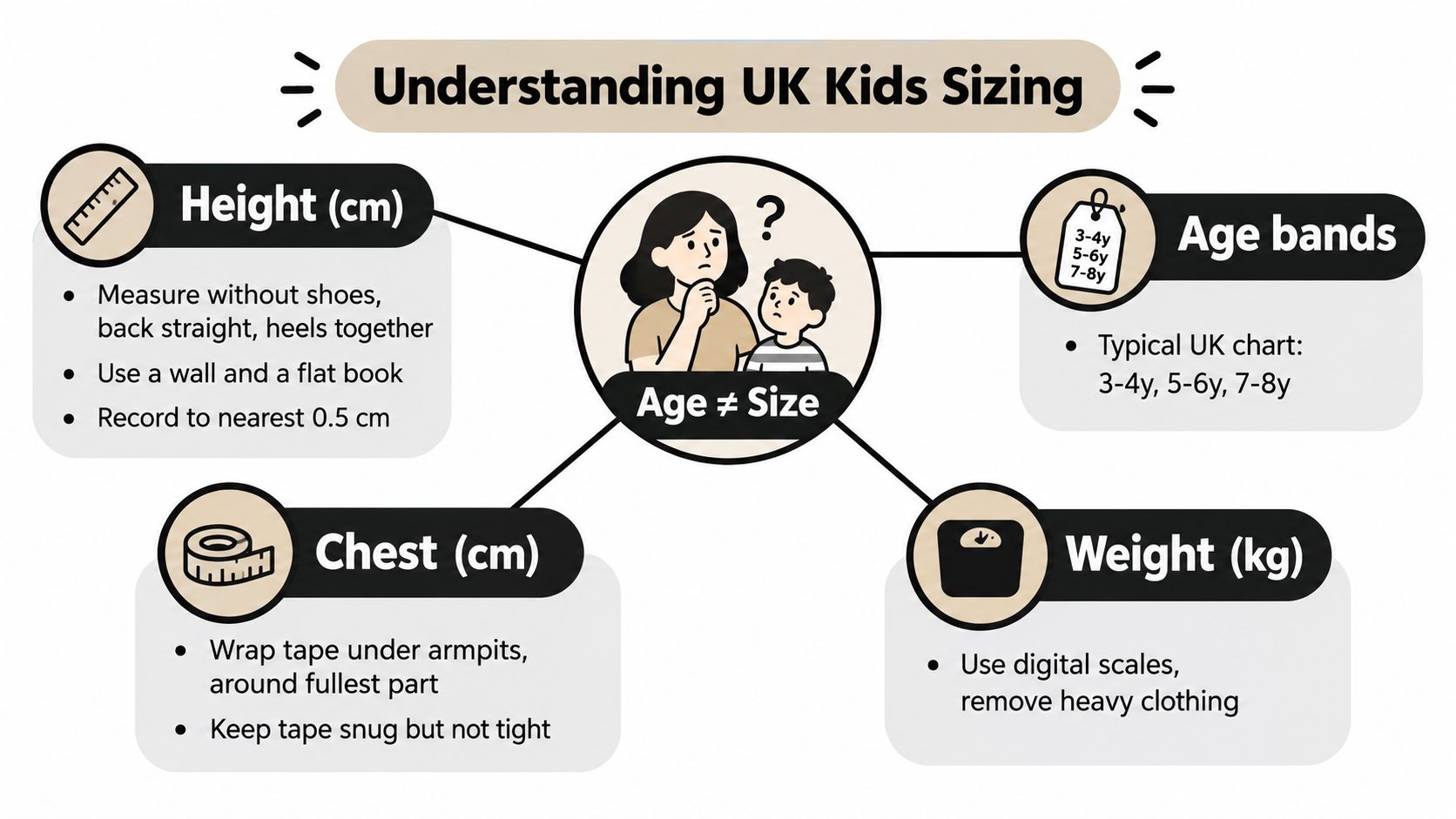
Some charts cover a narrower age range than others. A current UK chart from The White Company maps clothing to age bands and measurements from 1–1½ years through 5–6 years, which is a useful reminder to check the individual retailer's system rather than assuming every brand uses the same labels (The White Company children's size charts).
For a practical measuring method, the Little Venture Co. size chart provides another useful reference for comparing baby and children's clothing measurements. Keep the figures in your phone, especially when buying gifts or replacing an item after a growth spurt.
Fit uncertainty has a direct cost. Research on fashion e-commerce returns links 17% of returns to bracketing, while leading reasons include an item being too small at 22% or too big at 18.5% (The Billion-pound Question in Fashion E-commerce.pdf)). Measuring won't remove every mismatch, but it gives you a stronger starting point than ordering several ages and hoping one works.
A fabric choice should answer a practical question: what will this garment need to survive? A soft everyday top may be ideal for nursery or lounging, while a school trouser needs a construction that tolerates sitting, kneeling and repeated washing. Read the fibre content, care label, stretch information and fastening details together rather than judging a garment by touch alone.
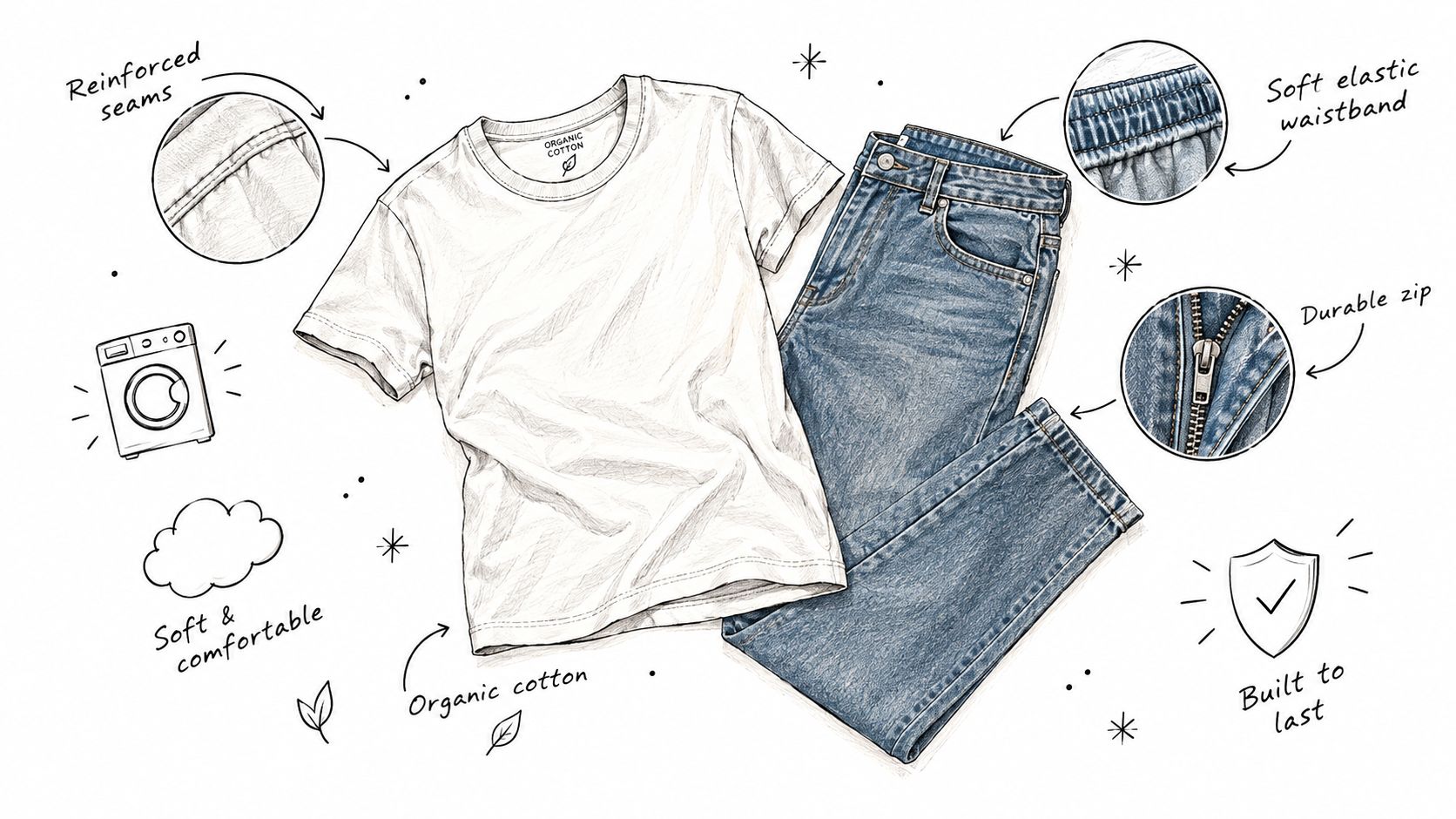
Cotton is often a practical choice for everyday layers because parents can assess its listed composition and care instructions easily. Linen or cotton-linen blends can suit warmer-weather clothing, but they may crease differently and need a care routine that matches the product label. This guide to cotton linen fabric blends and care is helpful when you're comparing the feel and upkeep of those materials.
Synthetic fibres can bring useful properties such as resilience or quick drying, but the product page should tell you exactly what has been used. Don't assume a fibre blend is automatically cooler, softer or more durable. Check the actual description, construction and washing instructions.
For active toddlers, reinforced knees, adjustable waists and simple fastenings can matter more than a fashionable finish. An adjustable waist may extend the useful fit of trousers, while an easy pull-on design can help a child practise dressing independently. For babies, poppers, envelope necks and wide openings can make frequent changes less awkward.
Use the catalogue description as your evidence. If a listing doesn't state a material, certification, performance feature or care instruction, don't fill the gap with an assumption. The same rule applies to claims about softness or suitability for a particular sensitivity. You can choose a garment for its listed construction and feel, but avoid turning that choice into a medical promise.
Peppervale's article on bamboo fabric clothing can add context when you're reviewing fibre descriptions. For any current item, the live product page remains the place to confirm what the garment is made from and how it should be washed.
A useful comparison looks like this:
| Need | Features to check | Why it matters |
|---|---|---|
| Nursery play | Wash instructions, flexible shape, secure fastenings | Clothing needs to cope with movement and regular cleaning |
| School days | Hard-wearing areas, practical colour, easy care | Repeated use makes construction important |
| Baby changes | Wide openings, poppers, soft-feeling listed fabric | Faster dressing can make busy changes easier |
| Outdoor activity | Layer-friendly cut, suitable outer fabric, stated care details | The garment must work with the child's routine |
A useful year-round wardrobe starts with layers, not isolated outfits. UK weather can change during the school run, so a child may need a comfortable base, a removable middle layer and an outer layer that suits the conditions. This approach also prevents overbuying because the same basic pieces can work across several months.
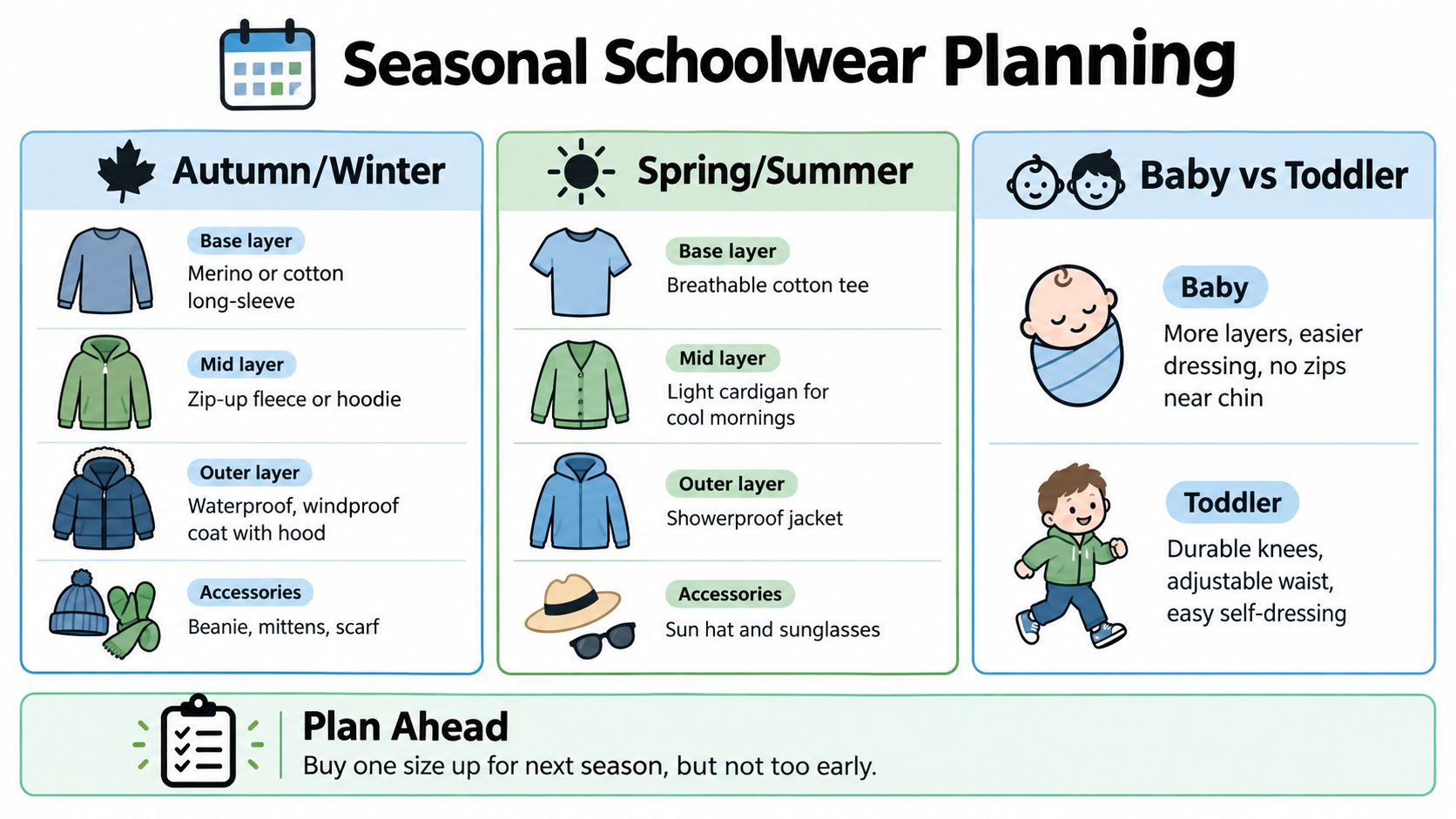
For autumn and winter, begin with a comfortable long-sleeve layer, add a jumper, fleece or hoodie, then choose a coat that leaves enough room for movement. Hats, gloves and suitable footwear complete the practical system. Avoid buying a coat so large that the sleeves cover the hands or the shoulders slip, because extra room only helps when the child can still move safely and comfortably.
Spring and summer need a lighter arrangement. A breathable top can pair with trousers, shorts or a skirt, while a cardigan or light jacket handles cooler mornings. A showerproof layer may be useful for changeable weather, but check the product description rather than assuming any lightweight jacket is waterproof.
Schoolwear rewards repeatability. Choose pieces that combine with the child's existing wardrobe, wash according to a realistic routine and allow independent dressing where possible. The kids winter coat size guide for the UK offers further help when outerwear is the item causing the most uncertainty.
Baby clothing is mostly about quick changes, comfortable positioning and reducing dressing friction. Look for accessible openings, practical poppers and layers that can be adjusted without pulling clothing over the head unnecessarily. Babies may need several changes during a day, so a small rotation of easy-care basics can be more useful than a drawer full of occasionwear.
Toddlers need clothing that supports movement and growing independence. Adjustable waists, flexible fabrics, durable knees and pull-on shapes can help with climbing, play and potty training. A toddler's outfit should survive activity without making toileting or dressing harder.
Plan ahead carefully. Buying one size up can make sense for a coat or basic layer intended for a later season, but an oversized current outfit may bunch, drag or feel uncomfortable. Keep the decision tied to the garment's purpose, the child's present measurements and the time of year you'll use it.
A capsule wardrobe doesn't mean owning very little. It means choosing pieces that work together, cover the child's actual routine and don't duplicate what's already in the drawer. Start with the week rather than an imaginary lifestyle. A child who attends nursery, plays outdoors and needs school clothing has different priorities from one who mainly needs weekend outfits.
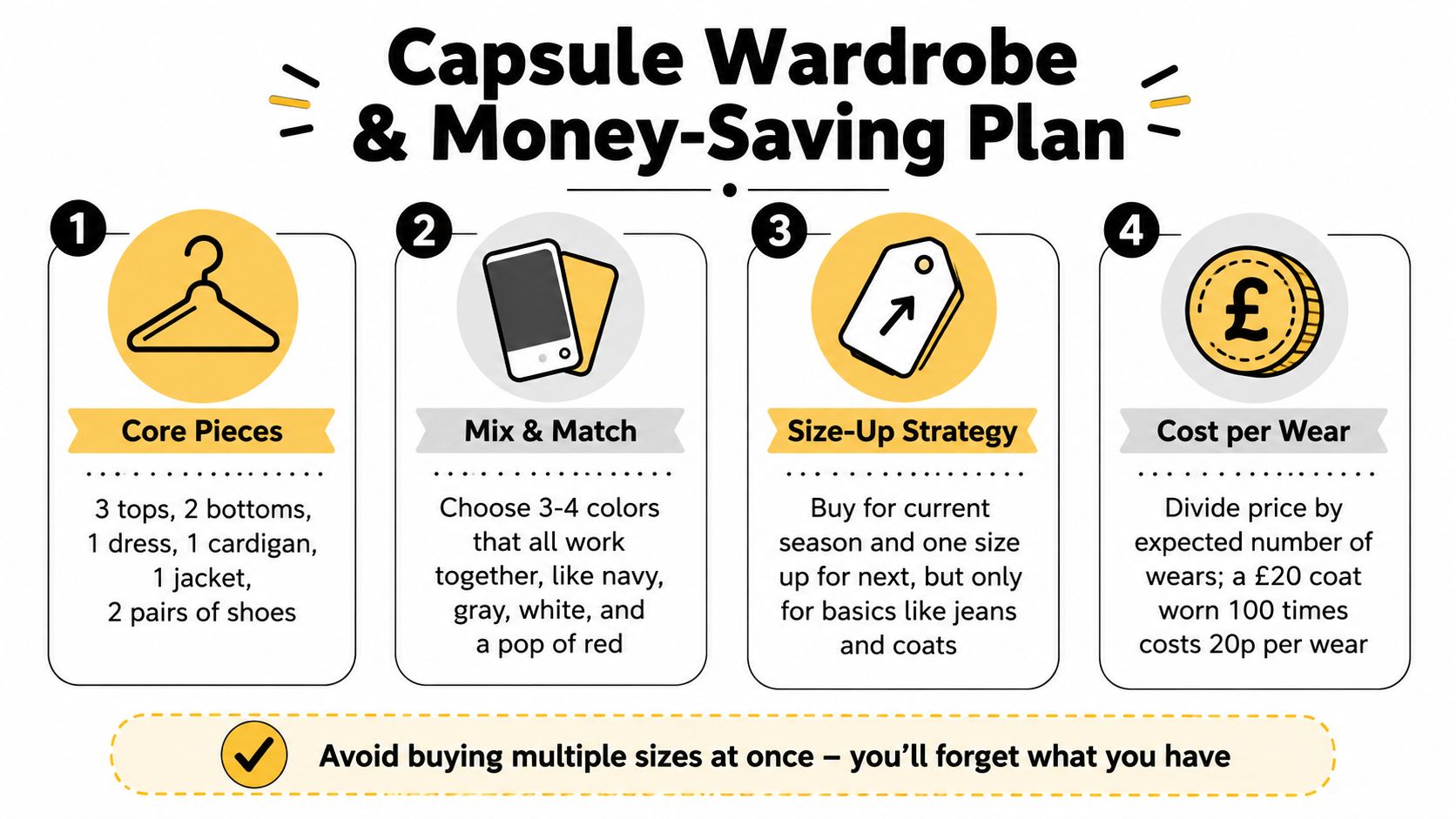
Begin with tops and bottoms that can combine across the week. A small colour family, such as navy, grey, white and one brighter accent, makes matching easier without making every outfit identical. Add a cardigan or sweatshirt, a jacket and footwear that suit the child's real activities.
Before buying, ask three questions:
Size up when the garment has useful adjustability, needs a layering allowance or is intended for a later season. Coats and relaxed basics may tolerate modest extra room. Size up less readily for fitted trousers, structured tops, footwear and anything that must stay in place during play.
Buying several sizes at once often creates confusion. Children can grow unpredictably, and forgotten items may be outgrown before they reach the front of the drawer. Keep a simple note of what you own, what fits and what needs replacing.
Think in cost per wear, not just purchase price. A well-used coat may offer more value than a cheaper item that becomes uncomfortable, difficult to wash or unsuitable after a few outings. This doesn't require a precise forecast. Count the likely uses, then compare durability, versatility and care alongside the price shown on the live product page.
The video below offers another visual way to think about organising a child's clothing choices.
A good capsule leaves room for favourites. Keep a much-loved jumper or dress if it still fits and works with other pieces. Replace only the weak link, rather than rebuilding the entire wardrobe whenever the season changes.
Clothing lasts longer when the care routine matches the label. Check the washing temperature, drying guidance, fastening instructions and whether the garment should be washed inside out. Closing zips and poppers before washing can protect both the item and other clothes, while prompt stain treatment may reduce the need for aggressive cleaning later.
Drying also affects everyday wear. Reshape knitted items while damp if the care label allows it, avoid storing clothes before they're fully dry, and use drawers or hangers that don't stretch shoulders or waistbands. Small repairs, such as replacing a loose button or securing a hem, can keep a useful garment in rotation instead of sending it straight to the bin.
For families, sustainability often begins with buying fewer unsuitable items. Measurement-first sizing can reduce avoidable exchanges, while versatile colours and hard-wearing construction support repeated outfits. Passing garments to siblings, friends or community reuse schemes gives them another purpose when they no longer fit your child.
Keep fibre and care claims grounded in the product information. Don't describe an item as certified, hypoallergenic, therapeutic or environmentally superior unless the live listing and an authoritative source clearly support that wording. A responsible product comparison says what is confirmed, identifies what needs checking and avoids promising performance the page doesn't state.
Children's nightwear is treated differently from ordinary daywear under the Nightwear (Safety) Regulations 1985 and related flammability rules (UK Nightwear Safety Regulations). Children's nightwear, with limited exceptions such as pyjamas, babies' garments and cotton terry towelling bath robes, must either meet specified flammability performance requirements after washing or carry the correct safety label.
Compliant labelling can include wording such as “LOW FLAMMABILITY TO BS 5722” or “KEEP AWAY FROM FIRE.” The important point is classification. A retailer should identify nightwear separately in product data, confirm the garment category and check that the wash label and fire-safety wording match the compliance route.
Safety check: Don't treat a sleepwear label as decoration. Confirm that the garment category, care instructions and fire-safety wording make sense together.
Daywear and sleepwear shouldn't be merchandised as interchangeable because both are made for children. Read the live listing carefully, follow the supplied wash instructions and keep nightwear away from naked flames, heaters and other ignition sources.
Confident online shopping starts before you add anything to the basket. Measure the child, write down the height, chest, waist and inseam where relevant, then open the individual product page and compare those figures with its chart. Check the stated material, care instructions, garment type and current size options. Don't rely on a search result, an old saved page or an age label without reading the details.
A broad store can be useful when the basket includes more than clothing. You might compare kids and baby essentials with footwear and accessories, then look at home and living items or other household categories separately. Peppervale's catalogue also includes women's and men's clothing, workwear, health and beauty and pet supplies, but each purchase still needs its own product-level checks.
Delivery information can change with stock, location, order contents and current store terms. Review the live delivery information before paying, especially if you're buying schoolwear for a fixed date or replacing a coat urgently. Don't assume that combining categories guarantees one parcel or a particular delivery speed.
The guide to an online clothing store in the UK can help you think through the wider browsing process, from comparing categories to checking product information. For a children's order, keep the practical sequence simple:
A well-planned basket is less about buying more and more about buying the right role for each garment. When fit, fabric, season and care all agree, children get clothes they can move in and parents get a clearer route through the next growth spurt.
Peppervale offers a live UK catalogue covering kids and baby clothing alongside footwear, accessories, workwear, home and living and other everyday household categories. Visit Peppervale to compare current options, check each product's measurements and care details, and build a practical wardrobe around the way your child really lives.


