Share:

- Women
- Men
- Kids & Baby
- Workwear
- Footwear
- Accessories
- Home & Living
- Health & Beauty
- Pet Supplies

You've ordered a “double” duvet cover online, washed the insert, and then discovered that the duvet rides up inside the case while the sides of the bed feel exposed. That frustrating result rarely comes from the label alone. It usually comes from a small difference between the actual duvet dimensions, the sewn cover dimensions, the fabric's behaviour after washing, and the bed underneath.
This duvet cover size guide UK focuses on fit rather than simple label matching. UK retailers generally work from familiar formats, but small variations still matter. A king cover may be listed at 225 x 220 cm or 230 x 220 cm, and a duvet cover is normally expected to match the insert rather than the mattress. The practical effect of a mismatch can be draughts, clumping filling, excess fabric under the sleeper, or a cover that drags towards one corner.
A duvet cover has one job before it adds colour or texture. It must hold the filled duvet evenly so the warmth stays where you need it. If the cover is too narrow, the insert compresses at the sides and can ride upwards. If it's too wide, the filling can shift inside the spare fabric, particularly when one person moves more than the other.
The UK market has stable reference sizes, but naming isn't a guarantee of identical cutting. Retailers commonly list a king duvet cover at either 225 x 220 cm or 230 x 220 cm, as shown in UK duvet and duvet cover sizing guidance. A difference of 5 cm in width may look insignificant on a product page, yet it can alter the way the insert sits, especially with a lofty natural filling or a cover that has a generous envelope closure.
The problem isn't limited to warmth. Excess fabric can bunch beneath a sleeper, pull the duvet towards one side, or leave the cover looking untidy after a night's movement. A tight cover can put pressure on corner ties and seams. On a deep mattress, the extra bed height can also make the duvet appear shorter at the sides, even when the cover and insert share the same nominal size.
Other bedroom details can expose poor fit. Pillow pairs may drift apart when the top edge is pulled unevenly, and a valance can look lopsided when the duvet repeatedly shifts across the bed. These effects become more noticeable in guest rooms, children's rooms and rented homes, where the mattress, topper and duvet may not have been bought as a matching set.
Practical rule: measure the duvet you own before choosing the cover. The bed label is only a starting point.
The useful checks are straightforward: measure the filled insert, confirm the cover's finished dimensions, consider depth and loft, then allow for the fabric's washing behaviour. That approach works better than assuming every “double” or “king” listing has been cut to precisely the same specification.
Measure the filled duvet first. Place it flat on the bed, smooth out obvious wrinkles without stretching the filling, and take the width across the longest filled edge from corner to corner. Then measure the length from the top edge to the bottom edge, keeping the tape straight and ignoring rounded corners.
For a cover, use its sewn, post-wash dimensions whenever possible. A cover hanging from a hanger may stretch under its own weight, while a cover laid flat gives you a more useful finished measurement.
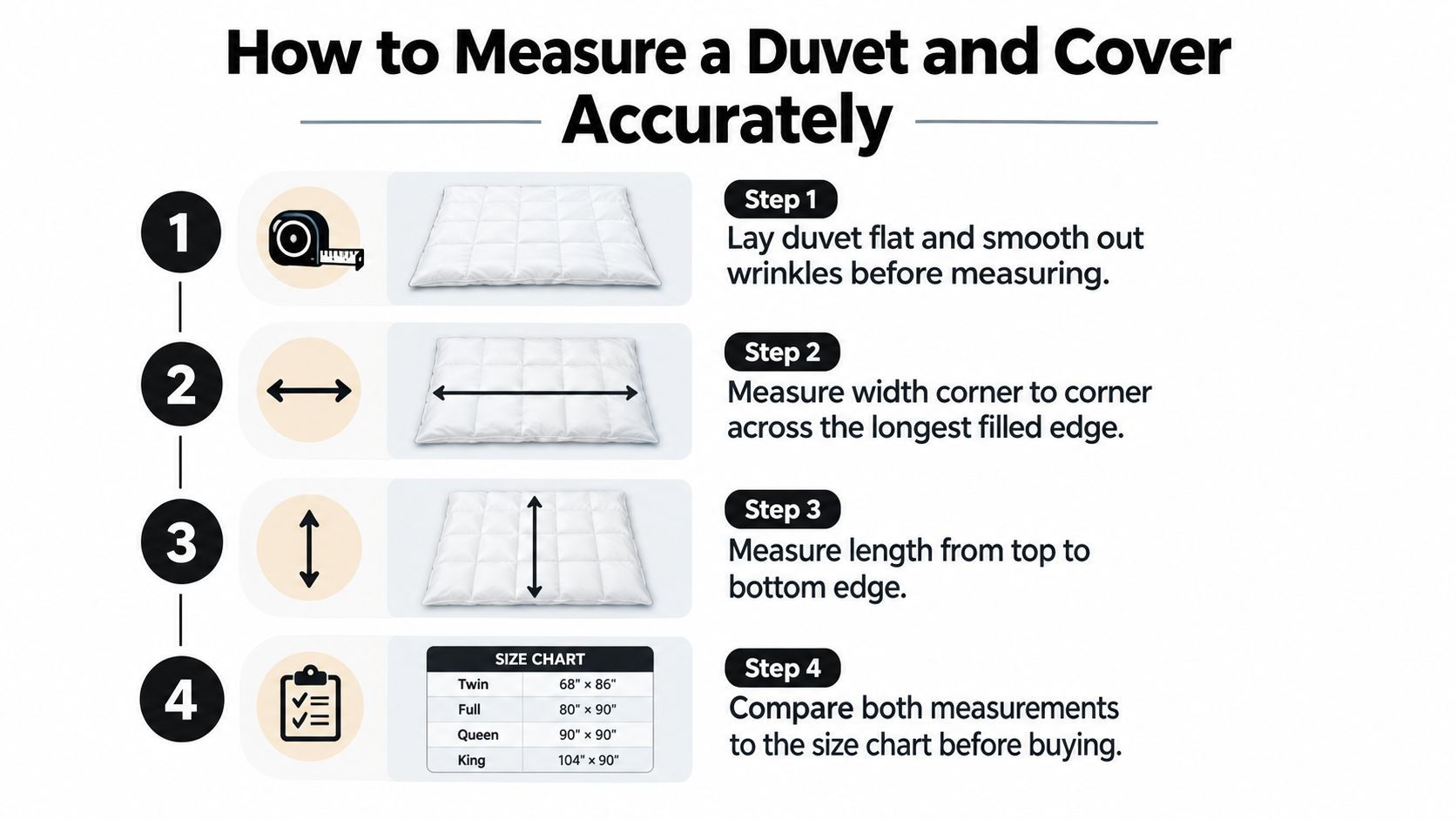
Run the tape along the piped or bound outer edge when you want the outside reading. For a closer approximation of the internal cut size, measure about one inch in from the seam, where the usable space begins. Don't pull hard on the fabric, particularly if it has a loose weave.
Closures also use space. Envelope flaps, button stands and zip panels can create 2 to 4 cm of dead space, so a cover advertised at 230 cm may provide only about 228 cm of clean internal room, depending on its construction. That's why two covers with the same headline dimensions can hold the same duvet differently.
Record the measurements in millimetres if you're comparing several product pages. It prevents rounding drift when one retailer displays whole centimetres and another gives a more exact specification. Finally, compare width with width and length with length. Don't rotate a cover to solve a sizing problem unless the construction, closure and pattern make that practical.
UK adult bedding is built around a small set of established formats. The table below gives the dimensions most commonly used by UK retailers and guides, with approximate inch conversions for shoppers comparing international listings.
| Size | Width x Length (cm) | Width x Length (in) | Intended bed | Typical pillow pair |
|---|---|---|---|---|
| Single | 135 x 200 | 53 x 79 | Standard single bed | Check product listing |
| Double | 200 x 200 | 79 x 79 | Standard double bed | Check product listing |
| King | 225 x 220 or 230 x 220 | 89 x 87 or 91 x 87 | Standard king bed | Check product listing |
| Super King | 260 x 220 | 102 x 87 | Super king bed | Check product listing |
| Emperor | 290 x 235 | 114 x 93 | Emperor bed or made-to-order larger bed | Check product listing |
The single format, 135 x 200 cm, is commonly paired with a standard single bed measuring 90 x 190 cm, as outlined in UK consumer duvet size guidance. The cover is deliberately larger than the mattress, allowing the duvet to hang over the sides and cover the sleeper rather than ending at the mattress edge.
A double cover measures 200 x 200 cm, while a king cover is generally 225 x 220 cm or 230 x 220 cm. That's a meaningful increase in width and length, not a minor upgrade from a double. Retailer size guidance also distinguishes these formats clearly, which is useful when an international product page uses a familiar name but a different measurement.
Super king adds substantially more width at 260 cm, while emperor reaches 290 x 235 cm. These larger formats can improve coverage for couples, but they also need enough room in the cover's internal construction for the filling to loft without being forced into corners.
Pillowcase pairings aren't universal. A set described as king may include pillowcases measuring 50 x 75 cm or 50 x 90 cm, so check the individual product details rather than assuming the pillow size from the duvet label.
Children's bedding needs more care than buying the next adult size down. Cot, cot-bed and junior products can use different dimensions, and nursery retailers may round their measurements for convenience. That rounding can make a cover feel tight on a deeper toddler mattress, particularly where the duvet has a thick edge or the cover has a substantial closure panel.
The following formats are useful reference points, but a child's actual duvet and the product page should decide the final purchase.
| Size | Dimensions (cm) | Dimensions (in) | Typical Age / Bed |
|---|---|---|---|
| Cot | Varies by product | Varies by product | Cot bedding, subject to the specific cot-dimensions listing |
| Cot bed | Varies by product | Varies by product | Cot bed used as a child moves beyond the smaller cot |
| Junior | Varies by product | Varies by product | Young child's junior bed |
| Long single | 90 x 190 | 35 x 75 | Taller child or teen using a long single bed |
| Standard single | 135 x 200 | 53 x 79 | Child or teenager using a standard single bed |
The long single format at 90 x 190 cm is easy to overlook. It suits taller children and teenagers who need more mattress length without moving to a wider adult bed. A standard single duvet cover may be too broad for that mattress, while a short junior option may limit comfort as the child grows.
A cot duvet shouldn't be treated as a substitute for a quilt or another product with a different construction. Use the bedding format intended for the child's bed, then check that the cover and insert dimensions correspond exactly.
Buying one size up can make sense when a child is already at the upper end of the recommended height range, but it isn't automatically better. Too much fabric can shift around a smaller sleeper, creating folds and an untidy sleeping surface. Measure the existing duvet, inspect the mattress depth, and choose the larger format only when the next bed stage is close enough to justify it.
International bedding names cause trouble because the same word can describe different dimensions. A UK single at 135 x 200 cm is wider than a US twin equivalent, while a UK super king at 260 x 220 cm sits between common US king and California king proportions. A US “double” also doesn't translate neatly to the UK double format, where double commonly refers to a 200 x 200 cm duvet cover.
| UK Size | UK (cm) | EU Equivalent (cm) | US Equivalent | Notes |
|---|---|---|---|---|
| Single | 135 x 200 | Varies by market | Twin or Twin XL, neither is an exact match | UK single is wider than a typical US twin |
| Double | 200 x 200 | Varies by market | Full or double, dimensions vary | Confirm the centimetres rather than the word |
| King | 225 x 220 or 230 x 220 | Varies by market | Queen or king, depending on the listing | A US queen isn't a guaranteed UK king match |
| Super King | 260 x 220 | Varies by market | King or California king, neither is exact | UK super king sits between common US proportions |
“European single” isn't a dependable measurement because formats vary by country and retailer. IKEA-style listings may also use names that look familiar while following their own size conventions. The safest approach is to compare the actual width and length of the duvet with the cover's finished measurements.
A thicker insert needs extra caution. If the duvet is noticeably loftier than the cover was designed to accommodate, rounding up may give the filling more room, but it can also create loose fabric and movement. Don't assume a US queen will fit a UK king cover, or that a US king will provide the same side coverage as a UK super king.
For an international purchase, save the product dimensions, not just the size name. Check the closure position, internal ties and return conditions before ordering, because a familiar label won't correct a dimensional mismatch.
Duvet thickness and mattress depth are separate measurements. The duvet's loft affects how much room the cover needs internally, while the mattress drop affects how far the bedding must fall over the sides of the bed.
Measure mattress drop from the top sleeping surface to the base of the mattress, including any topper. A mattress measuring 30 cm with a 4 cm topper creates a 34 cm sleeping surface, so a cover or bedding arrangement that worked before the topper may now sit higher and expose more of the sides.
Check the cover's piping-to-piping width on the live product page where that measurement is supplied. Cover depth is often described through construction rather than a separate “depth” number, so look for boxed corners, gussets, quilting and the manufacturer's internal dimensions.
As a practical guide, construction depths may be described as:
The right choice depends on how the duvet is made, not just its tog label. Boxed fillings need room to expand without being compressed against the cover, and natural fills can loft further after laundering. A cover 3 to 4 cm deeper than the duvet can provide a comfortable allowance for that movement, provided the width and length remain controlled.
Measure the complete sleep surface. A topper changes the effective height even though the mattress label hasn't changed.
For warmth and fill guidance, compare your duvet choice with this practical UK winter duvet tog guide. The cover still needs to fit the insert itself, but the bed's depth determines how the finished duvet will drape.
Buying a larger cover doesn't solve every fit problem. A cover that is too roomy may look generous when first placed on the bed, yet the insert can move within it during sleep. For example, a 230 cm cover on a 220 cm duvet leaves excess width that can bunch and pull the insert towards one corner.
Shrinkage adds another variable. A cover can lose 2 to 4 cm per side after the first three warm washes, with the amount depending on the fabric and construction, as noted in UK duvet cover washing and sizing advice. Treat the stated measurement as a specification to verify, not a promise that the fabric will remain unchanged through laundering.
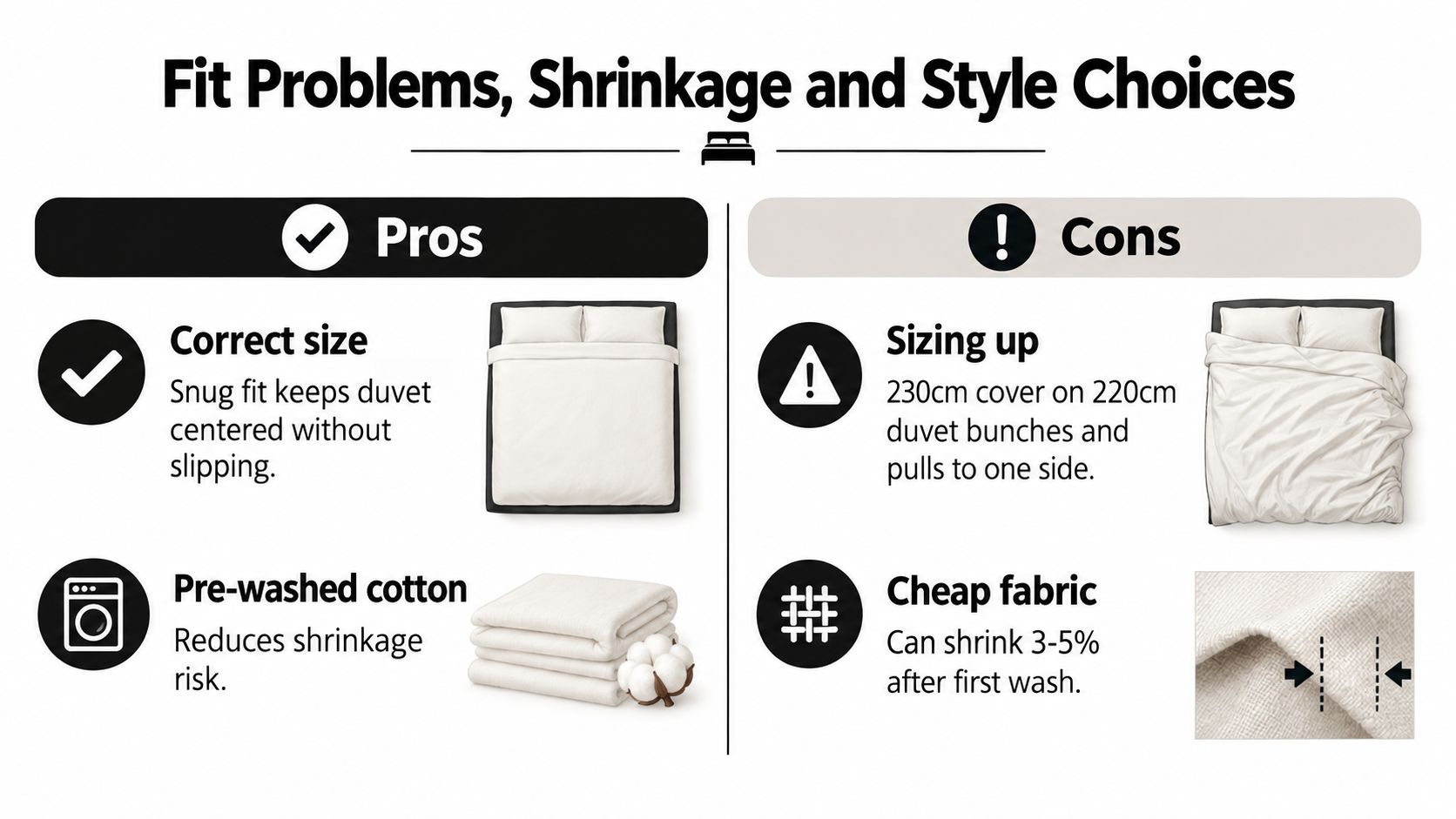
An oversized cover can flatter a guest bed where appearance matters more than close sleeping fit. On a single bed, however, extra fabric may feel cold because the duvet settles away from the sleeper. A correctly sized cover keeps the insert centred, while corner ties or clips can reduce movement further.
Fabric choice affects the trade-off. Pre-washed fabric may reduce the surprise of later dimensional change, while a cheaper, looser construction can alter more noticeably in the wash. Bamboo, cotton and polycotton each need their own care instructions, so follow the live product guidance instead of applying one laundry rule to every cover.
Natural filling also changes shape as it lofts and settles. Before assuming the retailer's chart is wrong, wash the cover according to its instructions, dry it fully, then re-measure both the cover and duvet. If the cover has become smaller, the issue may be shrinkage rather than the original size label.
For households prioritising regular washing, consult this UK bedding guide for allergy-conscious choices, then make sure the selected cover still matches the insert dimensions.
Peppervale's bedding listings use familiar UK categories such as single, double, king and super king. Treat the category as a useful filter, not the final fit decision. Open the live product page and locate the exact dimensions in centimetres before adding anything to your basket.
Start with the size table in this guide, then compare it with the listing's measurements. If the product page separates the duvet cover from the pillowcases, check both parts. A cover may be sold alone or as a set, and matching pillowcases can use different dimensions from the cover itself.
Look for these details:
The catalogue includes options across Peppervale's home and living range, so shoppers can begin with the relevant bedding category and narrow their selection by the size they have measured. For a closer look at how sets are presented, use this duvet cover set buying guide.
If a listing specifies bamboo, check its own care notes rather than assuming every bamboo cover behaves identically. Cooler washing and line drying may be recommended, and the feel can differ between 200 and 400 thread counts. Thread count alone doesn't tell you whether a cover will suit your sleeper, so use it alongside the weave, closure, dimensions and washing instructions shown on the live page.
Some bamboo covers may be cut slightly oversize to allow for natural shrinkage. If that information appears on the product page, don't downsize to compensate. The intended finished fit already accounts for the fabric's expected behaviour.
The closure changes how the duvet behaves during bed-making, washing and everyday use. It also affects how easily you can repair or replace a component if something fails.
| Feature | Buttons | Zip | Envelope |
|---|---|---|---|
| Everyday use | Traditional, but slower to fasten | Quick and fully enclosed | Simple folding construction |
| Laundry behaviour | May catch on delicate items | Keeps the insert contained | Tolerates rough handling well |
| Failure point | Individual button can be replaced | Slider or teeth may fail | Open end can allow slight movement |
| Suitable household | Heritage-style bedroom | Frequent washing routine | Rentals, children's beds and practical use |
Buttons suit a traditional bedroom and are easy to replace if one pops off. They take longer to fasten, and loose buttons can catch on delicate laundry. A zip seals the duvet inside the cover, which helps limit fill migration in the wash, but a failed slider can make the whole cover awkward to use.
Envelope closures fold the fabric inside at one end. They're forgiving during quick changes and can cope well with children's beds or rental changeovers, although the opening leaves a little more opportunity for movement at the end of the insert.
Corner ties are separate from the main closure. They can help hold a lofty duvet in place, but inspect the stitching around them and the internal seams. Piped edges may improve the finished outline, yet they can also reduce the usable internal measurement if the piping is substantial.
A zip is practical for a household that washes bedding frequently. Buttons work well where appearance and repairability matter most. Envelope construction is often the sensible compromise for a guest room, rented home or child's bed.
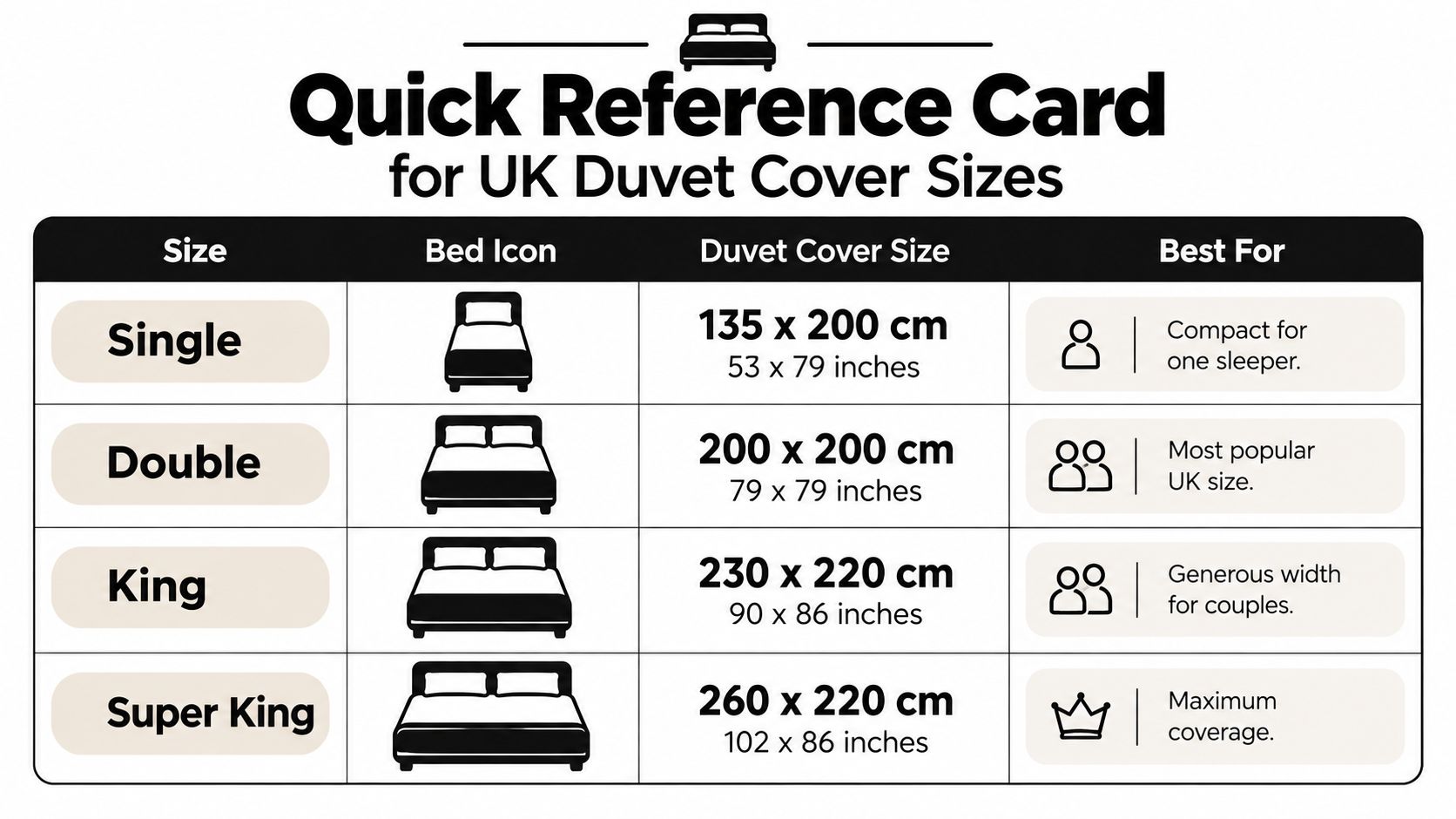
Keep this card open while comparing product pages. The figures are the common UK reference dimensions, but the live listing should always decide the final purchase.
| UK size | Centimetres | Inches |
|---|---|---|
| Single | 135 x 200 | 53 x 79 |
| Double | 200 x 200 | 79 x 79 |
| King | 225 x 220 or 230 x 220 | 89 x 87 or 91 x 87 |
| Super King | 260 x 220 | 102 x 87 |
| Emperor | 290 x 235 | 114 x 93 |
The key rules are simple:
For a complete bedroom refresh, shoppers comparing covers with everyday comfort bed frames can use the same measurement-first approach. Check the mattress, topper and duvet together, because the frame label alone won't tell you how the bedding will drape.
Before checkout, run three checks:
A UK duvet cover purchase comes down to three decisions. First, select the correct width and length for the insert. Second, allow for loft, mattress depth and any topper. Third, choose a closure that suits how your household makes beds and washes bedding.
The familiar reference points are 135 x 200 cm for single, 200 x 200 cm for double, 225 x 220 cm or 230 x 220 cm for king, and 260 x 220 cm for super king. Emperor bedding is commonly listed at 290 x 235 cm. These measurements help you shortlist products, but they don't replace checking the exact centimetres on the live page.
Depth is where many otherwise sensible purchases fail. A thick duvet can feel restricted inside a shallow construction, while an oversized cover may allow the insert to slide and bunch. Measure the complete sleep surface, including any topper, then look for the cover's construction details, internal ties and closure position.
Peppervale's bedding and home categories provide a practical place to apply these checks while comparing current listings. Read the live product information, confirm the set contents and don't rely on an old cached size chart, particularly if you're shopping across single, double, king or super king formats.
Use this final checklist:
Measure your duvet before browsing, then use the live bedding and home listings at Peppervale to compare the matching UK size, cover construction and set details. Choose the product page that gives you the clearest centimetre measurements, and add it to your basket only after the insert, depth and closure all make sense together.


