Share:

- Women
- Men
- Kids & Baby
- Workwear
- Footwear
- Accessories
- Home & Living
- Health & Beauty
- Pet Supplies

You're under the loft in a typical British terrace, the duvet has started feeling damp by 2am and your partner is radiating heat like a storage heater. You've tried opening the window, changing the tog rating and blaming the mattress. Then you see bamboo bedding promising cooler, softer, more sustainable sleep.
Some of those claims have substance. Others depend on whether the fabric is bamboo viscose, bamboo lyocell or a blend, how it's knitted or woven, and whether you'll follow the care label. This guide cuts through the green and cooling language so you can judge the bamboo bedding benefits against your room, skin, washing routine and budget.
Bedding can make or break sleep comfort. Thread count gets plenty of attention, but a high number won't solve a clammy duvet or a bedroom that stays warm after the central heating has gone off. For many UK homes, moisture management and airflow matter more than a glossy thread-count claim.
Bamboo bedding has moved from a niche natural-fibre idea into a familiar option across UK bedding shops and marketplaces. The problem is that “bamboo” can describe fabrics with different constructions and processing methods. A silky bamboo-viscose sheet and a bamboo-cotton blend may feel very different after washing, even though both appear under the same broad label.
Published textile research supports the comfort story, but it doesn't support treating every bamboo product as identical. Increasing bamboo content in knitted fabrics has been linked with improved moisture-vapour transmission, air permeability and thermal behaviour. One peer-reviewed study recorded thermal conductivity as low as 0.031 W/mK for a bamboo-based knit blend, compared with 0.036 W/mK for a comparable bamboo-cotton blend, meaning heat moved more slowly through the bamboo-rich fabric (textile research on bamboo thermal behaviour).
Practical rule: Buy bamboo for a specific sleep problem, not because the label sounds premium.
The right question isn't “Is bamboo bedding good?” It's “Which bamboo construction suits this bedroom and this laundry routine?” Hot sleepers, people who dislike rough textures and households washing bedding frequently may find a strong reason to try it. Someone who wants a crisp, structured sheet that lasts through rough treatment may still prefer good cotton.
The bamboo plant doesn't arrive on your bed as a woven grass. Most bamboo bedding uses regenerated cellulose fibre. Manufacturers break bamboo down into pulp, dissolve the cellulose and re-spin it into textile fibres. The result feels soft and fabric-like, but the processing route matters.
Bamboo viscose, also called bamboo rayon, is the most common form on UK shelves. Think of the bamboo pulp as a smooth mixture, similar in principle to soft-serve before it is shaped. The dissolved material is pushed into fibres, spun into yarn and made into bedding.
It usually gives you a silky hand-feel, fluid drape and accessible pricing. That makes it attractive for shoppers who want soft bedding without moving into the highest price tier. The trade-off is that the word bamboo alone tells you very little about chemical controls, durability or environmental performance.
Bamboo lyocell follows a different regenerated-cellulose route. A closed-loop process recovers and reuses the processing solvent, which can give the fabric a stronger sustainability story when the product page provides credible evidence.
The texture is still smooth, but lyocell often feels a little more controlled and substantial than a very fluid viscose. It generally costs more because the fibre and manufacturing process are positioned at a higher specification. Don't assume the price alone proves quality, though. Check the composition, weave, certification and care instructions.
A blend combines bamboo-derived softness with cotton's more familiar structure. It's the sensible compromise for shoppers who want a smoother feel but don't want the drape of a very silky sheet.
A label should state the fibre composition clearly. Look for terms such as bamboo viscose, bamboo rayon, bamboo lyocell, cotton and the blend proportions. If it only says “bamboo bedding” without naming the actual fibre, the description isn't doing enough work for you. Peppervale's bamboo fabric explainer offers useful background on how bamboo-derived textiles differ from the plant itself.
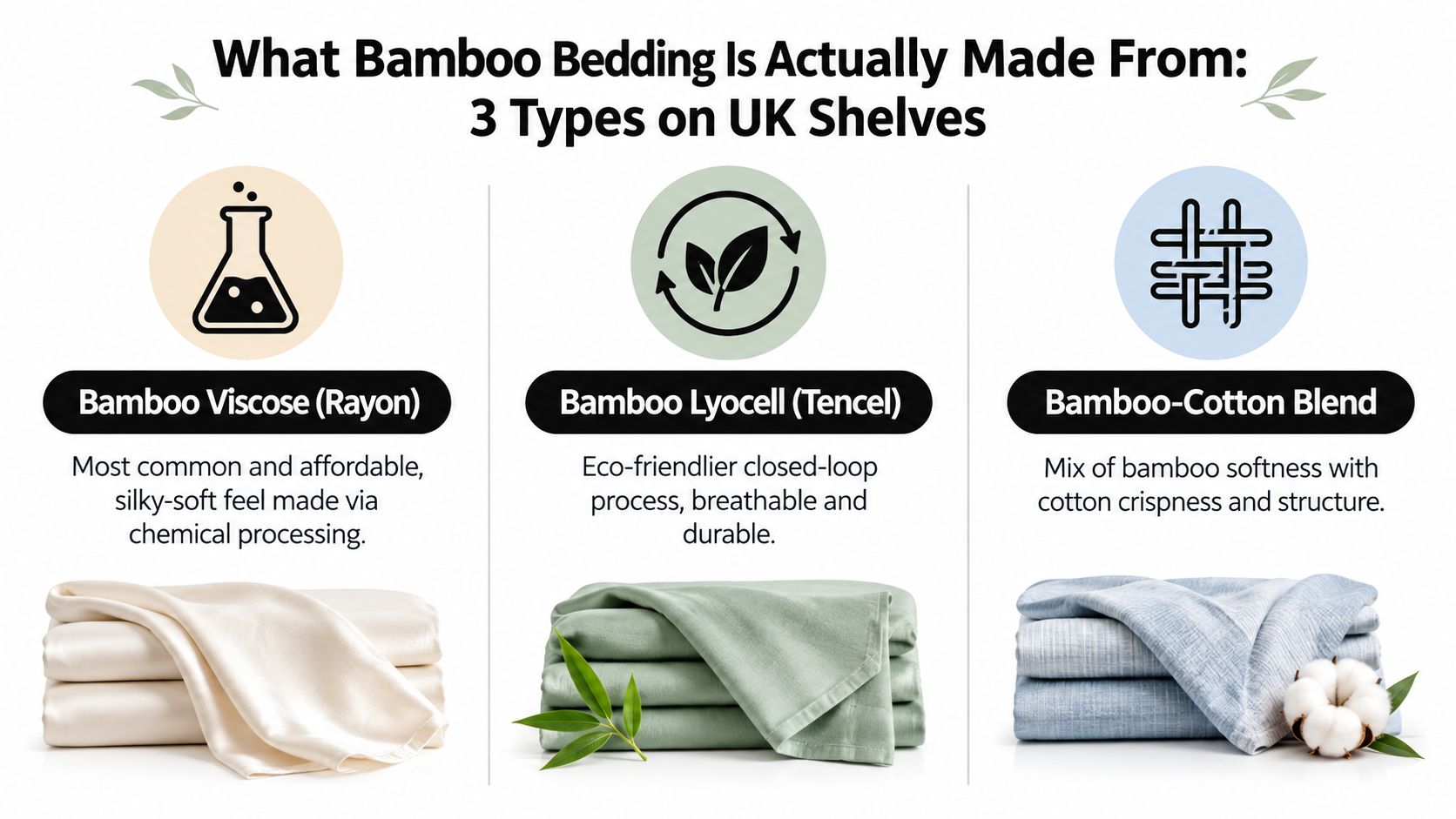
This short visual guide also helps separate the three labels before you start comparing colours and sizes.
The strongest bamboo bedding benefits are physical rather than fashionable. Smoothness, airflow and moisture movement can change how the bed feels, particularly if you wake hot or dislike fabric sticking to your legs.
Bamboo viscose and lyocell usually have a smooth surface because their regenerated fibres are comparatively uniform. That reduces the rough sensation you can get from coarser or heavily textured bedding. It won't fix every skin problem, and it doesn't make the product automatically suitable for everyone, but the hand-feel is a genuine reason people choose it.
Textile studies found that increasing bamboo content can lower thermal conductivity and increase air and water-vapour permeability. The bamboo fibre's micro-gap and micro-hole structure contributes to wicking and ventilation, helping moisture move away from the skin so it can evaporate more quickly (peer-reviewed bamboo textile study).
That translates into a bed that may feel less clingy in warmer conditions. In a centrally heated bedroom, the benefit isn't that bamboo magically lowers the room temperature. It's that heat and sweat can move through the fabric more readily instead of sitting against your body.
Fabric construction still matters. Plain knits generally perform better for airflow and vapour transfer than rib and interlock structures, so fibre content isn't the whole decision. A well-engineered bamboo blend can feel more comfortable than a poorly made “100% bamboo” sheet.
| Fibre | Hand-feel | Relative breathability | Moisture absorption vs cotton |
|---|---|---|---|
| Bamboo viscose | Smooth and silky | Generally good, dependent on construction | Can be strong, but not universally superior |
| Bamboo lyocell | Smooth, light and controlled | Good, with performance shaped by weave and density | Strong moisture management is commonly reported |
| Bamboo-cotton blend | Softer than standard cotton, with more structure | Varies with the blend and fabric construction | Depends on bamboo share and yarn engineering |
A comparative study found that regenerated bamboo fabrics have excellent moisture and temperature management properties, but aren't superior to cotton or viscose across every comfort measure. Fibre blend, yarn twist and fabric density can change the result (comparative regenerated bamboo fabric research).
Bamboo can help a hot sleeper feel drier, but a thick duvet can still trap heat above the sheet.
Bamboo is a strong comfort choice, not a universal winner. Cotton still has the edge for shoppers who want a crisp, familiar surface, while linen remains the more textured option for people who prioritise an airy, relaxed bed.
| Criterion | Bamboo, viscose or lyocell | Cotton, percale or sateen | Linen |
|---|---|---|---|
| Feel against skin | Smooth, silky and fluid | Percale feels crisp, sateen feels smoother | Textured at first, softer with use |
| Warmth | Comfortable across seasons when fabric weight is sensible | Versatile, with sateen often feeling warmer than percale | Airy and less clingy in warmth |
| Night-sweat handling | Strong moisture-management potential, depending on construction | Reliable, but can feel clammy in humid conditions | Excellent airflow with a drier, more textured feel |
| Washing | Follow the label, often gentle and cooler washing | Generally forgiving | Can crease heavily and needs suitable care |
| Longevity | Lyocell can be robust, viscose needs kinder handling | Good cotton can be very durable | Often valued for long-term use when cared for properly |
| Best reason to choose it | Softness and moisture comfort | Crispness, familiarity and structure | Breathability and natural texture |
Bamboo viscose or lyocell beats cotton percale when you want a smoother, less crisp surface and your priority is reducing that sticky feeling. It may also suit you better than sateen if sateen's heavier finish feels too warm. On the other hand, high-quality cotton, including premium long-staple varieties, can win on crispness, structure and resistance to a careless wash routine.
Linen remains the cooler, more textured choice for hot sleepers who don't mind creasing. Bamboo is softer straight from the packet, but that softness can be less impressive if the sheet is dried harshly or overloaded in the machine.
Price needs checking at the point of purchase because it varies by fibre, weave, size and retailer. Bamboo-cotton blends usually sit closer to ordinary cotton than premium bamboo lyocell, while a lyocell set commands more when the manufacturing and certification information backs up the claim. Don't pay extra for vague “cooling” language when the listing won't tell you the fibre type or construction.
The words hypoallergenic and anti-bacterial deserve scrutiny. They're often used as if they guarantee relief, but a bedding label can't promise that every person with eczema, allergies or irritation will sleep better.
The useful part of bamboo is its smooth surface and moisture handling. Less friction can feel kinder against sensitive skin, while quicker moisture movement may help if sweat makes your bedding uncomfortable. UK editorial coverage also highlights bamboo's smooth, breathable and moisture-wicking qualities for hot sleepers and people concerned about skin sensitivity, while warning that these claims are often presented too broadly (UK bamboo bedding guidance).
An “anti-bacterial” statement may refer to a controlled laboratory test rather than a busy bedroom with body oils, sweat, detergent residue and repeated washing. Don't treat it as a substitute for cleaning. Regular laundering, complete drying and sensible mattress protection do more practical hygiene work than a marketing badge.
Bamboo may make sense if:
Don't choose bamboo solely because you have normal skin or because a listing says “natural antibacterial”. A well-washed cotton sheet may serve you just as well. If you have a diagnosed skin condition, allergy or breathing problem, treat bedding as a comfort and housekeeping choice, not a medical treatment. Look for an independently verifiable certification, clear fibre composition and a wash routine you'll maintain.
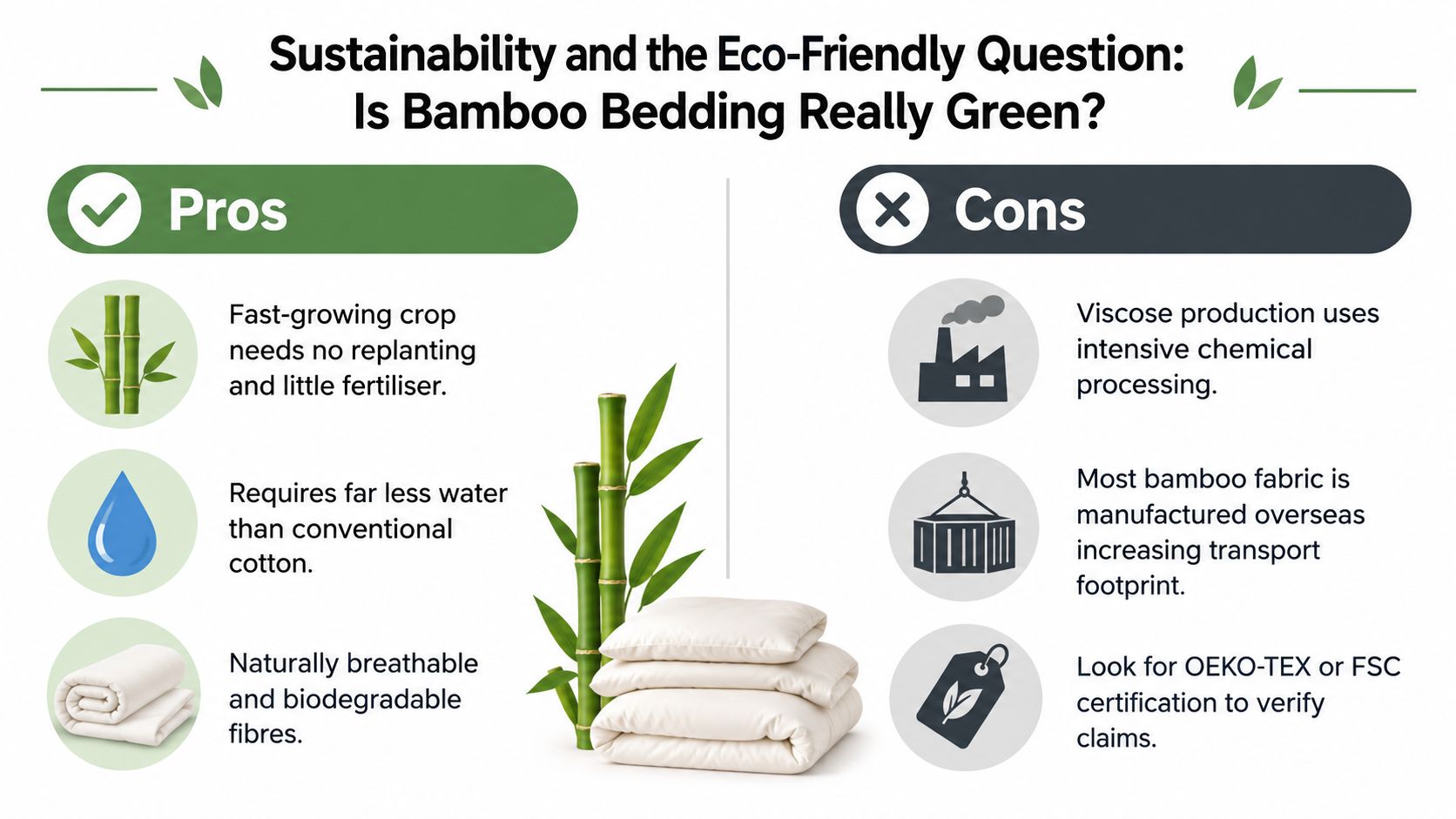
Bamboo has a persuasive green story. It's a fast-growing crop that can regenerate after harvesting and generally needs less agricultural input than many conventional textile crops. But a bamboo plant and a bamboo-viscose sheet aren't the same environmental product.
Most bamboo bedding sold in the UK is regenerated viscose or rayon. Turning the plant into soft fabric involves chemical processing, so the environmental result depends on factory controls, solvent recovery, energy, transport and product lifespan. The fibre label alone doesn't prove that a set is low impact.
Bamboo lyocell offers a more specific point of comparison. A UK bedding brand states that its bamboo lyocell uses a closed-loop process that recycles water and solvents. That type of detail is more useful than saying bamboo is sustainable, because it tells you something about the route from pulp to fibre.
The wider bedding market shows why end-of-life claims matter. The National Bed Federation reported that an estimated 6.4 million mattresses reached the end of their lives in the UK in 2021, with 24% sent for recycling that year, an increase of 5 percentage points from 2017 (National Bed Federation end-of-life report). The following report recorded an actual recycling rate after processing of only 14% in 2022, showing the difference between material being collected and material recycled.
The same NBF coverage later described real recycling rising from 14% in 2020 to 33% in a later report. The direction is encouraging, but it still underlines the point: disposal and processing determine the environmental outcome.
Use textile recycling banks or retailer take-back schemes where available, and don't assume every bamboo fabric is compostable. Blends, dyes, elastic, thread and finishes complicate disposal. For a more defensible purchase, check the fibre type, manufacturing information and certifications such as OEKO-TEX Standard 100, FSC, GOTS for organic cotton content and the EU Ecolabel. Peppervale's carbon-footprint explainer is also useful background when you're comparing the full product journey rather than just the crop.
Treat bamboo bedding as a soft, easy-care fabric, not an indestructible one. Bamboo viscose can feel wonderfully smooth but may be less resistant to abrasion than strong cotton, while lyocell is generally positioned as the more durable regenerated option. Your washing and drying habits will matter more than a high-sounding thread count.
Laundry reality: Bamboo's softness lasts longer when you reduce heat, friction and chemical harshness.
A good listing should answer practical questions without forcing you to guess.
Rotate two or three sets if your budget allows. Alternating bedding gives each set time to dry fully and reduces the wear placed on one fitted sheet, especially around the elastic and corners. Inspect seams after washing, because a soft fabric is no use if the construction doesn't suit your mattress.
Start with the sleeper, not the word “bamboo”. If you wake hot or clammy, choose a breathable bamboo lyocell or well-made bamboo-viscose fabric, then pair it with a duvet weight that doesn't undo the benefit. A sheet can move moisture away from your skin, but it can't stop an overly warm duvet trapping heat above you.
If softness and value matter most, a bamboo-cotton blend is the sensible middle ground. It should offer some bamboo-derived smoothness while retaining more structure than a fluid viscose sheet. If you prefer a crisp bed, want maximum familiarity or tend to wash without much care, good cotton may be the safer buy. Linen remains right for shoppers who like an airy, relaxed texture and don't mind heavy creasing.
For UK households, also check the available drying space, central-heating season and the dimensions of the fitted sheet. Peppervale's home textiles guide provides a starting point for browsing household options, but confirm the current listing details before ordering.
Buy one set first if you're unsure. Use it through a normal week, wash it according to the label and decide whether the feel, drying time and fit suit your routine before expanding the collection. That's a more reliable test than trusting a product description promising cooler, greener sleep.
Browse Peppervale to compare the current home and living range alongside practical household products, then check each bedding listing for its fibre composition, dimensions, care instructions, delivery charges and returns information. Choose the set that solves your actual sleep problem, not the one with the loudest bamboo claim.


